I Spent $400+ Testing Weight Vests So You Don't Have To
(Here's the Only One I'd Actually Recommend)

I coach general population clients. Office workers, weekend warriors, parents who train three days a week. Almost every one of them eventually asks about weighted vests.
The pitch is always the same: strap on some extra weight, turn your bodyweight workout into something more, get stronger without needing a squat rack. Simple enough in theory. In practice, I burned through $400 and six months of testing before I found one that didn't create more problems than it solved.
Here are the four vests I bought, what went wrong with each one, and the fifth vest that actually lived up to the hype.
Henkelion Weighted Vest (12 lbs)
Comfortable for a walk. Useless for everything else.

This is the vest Amazon recommends to everyone. It shows up first when you search "weighted vest," it has thousands of reviews, and it costs about as much as a decent lunch. I figured it was a low-risk way to test the concept with clients.
For walking? It's fine. The neoprene is soft, the iron pellet fill molds to your shoulders, and you barely notice it after a few minutes. I had a client wear it on morning walks for two weeks and she liked it.
Then we tried it for actual training. Push-ups, squats, lunges. The vest has no cinch straps, no way to lock it down. It bounced with every rep. During burpees it rode up to her chin. And at 12 pounds, my stronger clients outgrew it in a single session.
The real dealbreaker: the weight is permanently fixed. You buy a 12-pound vest, you get a 12-pound vest forever. No way to add or remove weight. When your body adapts (which takes about two weeks for most people), you need to buy a whole new one.
Fixed-weight vests like the Henkelion violate the most basic principle of strength training: progressive overload. If you can't add weight over time, your body has no reason to keep adapting. You plateau before you even start.
Bottom line: A $35 introduction to the concept. That's all. You'll outgrow it fast, and you can't adjust it when you do. Fine for dog walks, bad for training.
ZELUS Adjustable Weighted Vest (20-32 lbs)
The iron sand leaked onto my gym floor. Twice.

After the Henkelion, I wanted adjustability. The ZELUS comes with removable iron sand bags that let you increase weight from 20 to 32 pounds. It felt like a real upgrade on paper.
The adjustable weight is better than fixed, no question. But ZELUS solved the wrong problem. Each sand bag weighs about 1 pound, and you add or remove them from small Velcro pockets. Going from 24 to 28 pounds means pulling out the vest, opening four pockets, inserting four bags, closing four pockets, and putting it back on. I timed this at just over 3 minutes between sets.
The other issue is durability. Iron sand is abrasive. After six weeks, two of my sand bags had small tears at the seams. Fine dark powder on my gym floor. Not a crisis, but not something I want near my equipment or my clients' lungs.
The vest itself also runs warm. Neoprene traps heat, and during a 45-minute circuit, two of my clients complained about overheating before the workout was done.
Iron sand degrades the fabric that contains it. The abrasive particles wear through stitching and pocket linings over time, which is why sand-based vests tend to develop leaks within a few months of regular use. It's not a defect. It's a design limitation.
Bottom line: Adjustable in theory, frustrating in practice. The sand bags are slow to swap, prone to tearing, and the neoprene turns into a sauna. A step up from the Henkelion, but not by as much as the price suggests.
Titan Fitness Elite Series (40 lbs)
Built like a tank. Loading it feels like solving a puzzle.

The Titan felt like my first "serious" vest. Cordura nylon instead of neoprene. Cast iron ingots instead of sand bags. It looked like something a firefighter would train in. I was optimistic.
The construction is solid. Thick padding on the shoulders, reinforced stitching, D-rings on the back for sled attachments. At 40 pounds, it can handle intermediate and advanced clients. This is a vest that's built for real work.
But the loading system killed it. Each 2.5-pound iron bar slides into its own individual pocket. The 40-pound version has 16 bars spread across the front and back. Loading them means opening 16 Velcro flaps, sliding in 16 bars, and closing 16 flaps. I'm not exaggerating when I say it takes 10 minutes.
You also have to balance them manually. Put 5 bars in front and 3 in back, and the vest pulls you forward. Every time you adjust weight, you're doing math: how many in front, how many in back, are they even?
One more thing: the pocket closures feel flimsy relative to the rest of the vest. For a product that screams "heavy duty," the Velcro holding your weights in place is surprisingly thin. I had a bar slide out during box jumps. Not ideal.
Individual bar-loading systems require you to manually balance weight distribution between front and back panels. If the balance is off by even a few pounds, your posture compensates unconsciously, which can lead to lower back strain over time.
Bottom line: Great materials, terrible user experience. The vest itself is durable, but the loading process is so tedious that my clients stopped adjusting weight between exercises. They'd pick one weight and stay there all session. That's not progressive overload. That's settling.
MiR Short Weighted Vest (50 lbs)
The most weight I tested. Also the most time I spent loading a vest.
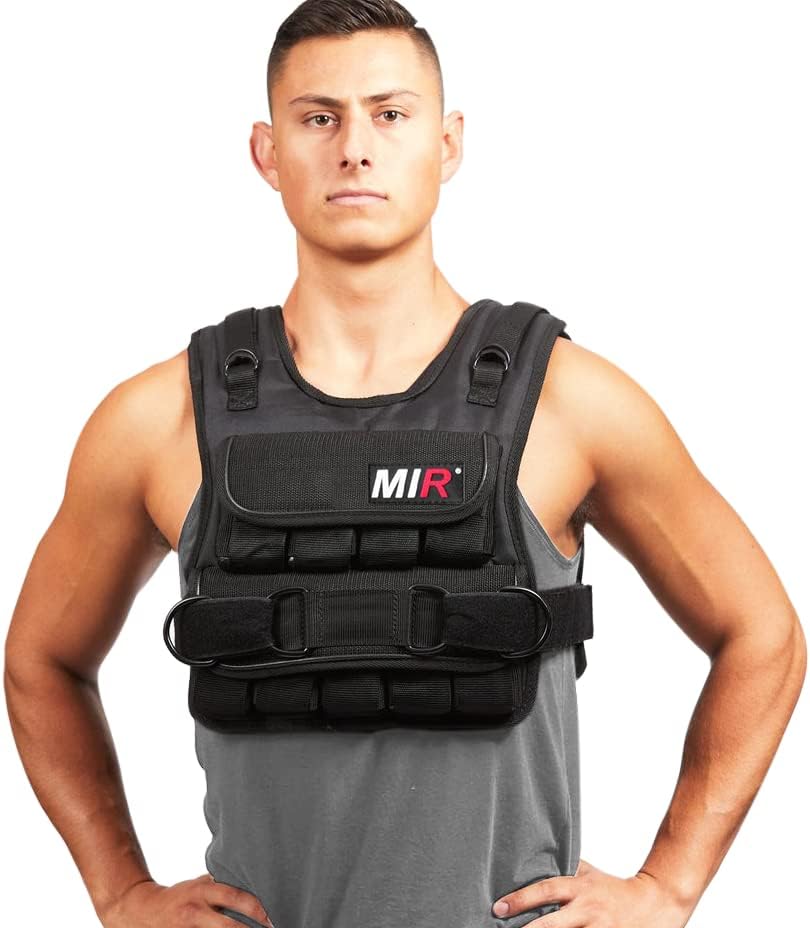
The MiR is a favorite in the CrossFit and firefighter training world. At $200 for the 50-pound version, it felt like the premium option that would finally end my search. Compact 11-inch design, heavy-duty 1200D nylon, capacity up to 60 pounds. On paper, everything checks out.
In practice, the MiR inherits the same fundamental problem as the Titan: individual iron bars in individual pockets. Except worse, because the MiR uses 3-pound bars instead of 2.5-pound bars. That means your smallest adjustment increment is 3 pounds. Want to go from 35 to 37 pounds? You can't. It's 33 or 36.
The loading ritual is the same: open pockets, slide bars, close pockets, balance front and back. At 50 pounds, that's 17 bars. One of my clients started calling it "vest homework."
The compact design is a genuine advantage for mobility. It rides high on the torso and doesn't interfere with hip flexion. But the shoulder padding, while doubled, starts to dig in above 40 pounds during longer sessions. Two clients mentioned shoulder soreness after 30-minute workouts at higher loads.
3-pound minimum adjustments might sound close enough, but research on progressive overload shows that smaller increments (1-2.5 lbs) produce more consistent strength gains with lower injury risk. Jumping 3 pounds at a time is like only having 10-pound plates for your bench press.
Bottom line: The MiR is a serious piece of equipment held back by an outdated loading system. Compact and high-capacity, but the 3-pound increments and bar-by-bar loading process make precise progressive overload impossible. At $200, it should be easier to use than this.
Kensui EZ-VEST: The Vest That Made Me Stop Looking.
The first time I loaded it, I grabbed a 25-pound plate off my squat rack, slid it on, locked the collar, and started training. The whole process took about 8 seconds. That was the moment I knew every other vest was obsolete.

A friend who coaches at a CrossFit box told me about the EZ-VEST after I'd given up on finding a vest I'd actually use in programming. His exact words: "It loads like a barbell." I thought he was overselling it. He wasn't.
The EZ-VEST uses standard Olympic weight plates. The same 2" plates on every squat rack in every gym in the world. No proprietary sand bags. No individual iron bars. No tiny pockets to stuff. You slide plates onto an aluminum post, lock them with a collar, and go.
This changes everything about how you train with a vest. Want to add 2.5 pounds next week? Slide on a fractional plate. Want to go from bodyweight warm-up to 50-pound working sets? Stack plates. Want to strip weight for a burnout set? Pull a plate off. It takes the same amount of time as changing weight on a barbell.
The frame is aircraft-grade aluminum. Empty, the vest weighs under 7 pounds. But the engineering supports up to 300 pounds of total load. That means the same vest works for the client doing weighted walks at 15 pounds and the client doing weighted pull-ups at 80. I stopped needing to own multiple vests for different clients.
The weight sits centered on your torso and locks in place. No shifting, no bouncing, no balancing act. During squats, the load tracks straight down through your center of gravity. During push-ups, it stays flat against your back. During walking lunges, it moves with you instead of fighting you.
As featured in:


Bottom line: The EZ-VEST solved every problem I had with the other four vests in one design. It loads like a barbell, adjusts in seconds, and scales from 5 to 300 pounds. After 10 months of daily use across a dozen clients, it's the only vest I recommend. It's the only one I own.
The Final Verdict
After $400+ and six months of testing with real clients, the pattern was clear: every traditional vest fails in the same way. They make adding or changing weight so tedious that people stop doing it. The Kensui EZ-VEST is the only vest that makes progressive overload as simple as it should be.
Stop wasting money on vests you'll outgrow. Try the one you won't.
Try EZ-VEST Risk-Free →100-day money-back guarantee • Free shipping on $100+ • Starts at $99
* This is a sponsored review supported by Kensui. All opinions, experiences, and product testing described in this article reflect the reviewer's genuine use. Product specifications, pricing, and availability are accurate as of the publication date and may change.