Engineering • 7 Min Read
Gymnastic Rings Have Not Changed Since 1811. An MIT Engineer Found Their Fatal Flaw.
One closed loop, one thickness, one number that was chosen for you. Your hand covers about a seventh of it. The rest of the circle has been holding that seventh in the air for two centuries and doing nothing else.

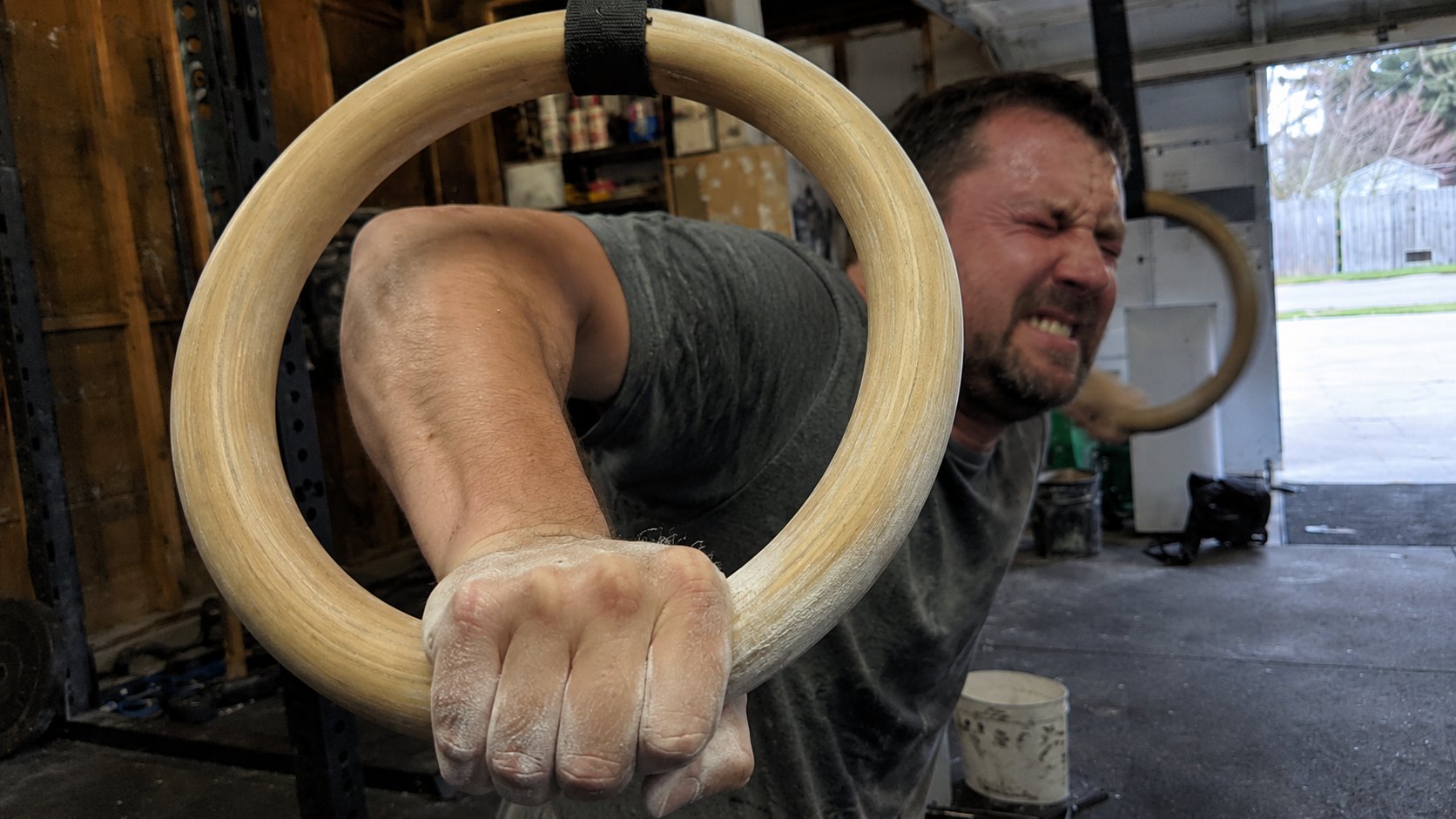
Hang from a set of gymnastic rings for thirty seconds. Chalk your hands first, because the evidence shows up better that way.
Now come down and look at the wood. There is a band of white about as wide as your palm, and on either side of it the ring is clean. That band is the entire part of the apparatus that has ever met your skin. Everything else on the loop is structure.
The numbers are not close, and they are in the box below. Roughly a seventh of the ring does the job, and the other six sevenths exist to hold that seventh in the air.
Dimensions from the FIG Apparatus Norms, section MAG 3, which fixes both figures to within a millimetre. The 65.3 cm is the centreline of the profile, so it is the path your palm follows rather than the inside edge.
None of that would matter if the six sevenths were free. They are not, because a ring is one piece of wood turned to one thickness the whole way round, so the part under your fingers has to match the part carrying the strap. One number, set once, for every movement you will ever do on it. I stopped filing this under trivia the week my ring dips started sliding and my pull-ups did not.
The One Number You Were Never Asked About
Two numbers are in circulation, and whichever one you own was printed on the box in smaller type than the weight rating. The first is 28 millimetres, which is not a preference but a rule. The International Gymnastics Federation's apparatus norm fixes the profile at 2.8 centimetres. Buy a set described as FIG standard and that is the number you are buying.
The second is 32 millimetres, which is what most of the calisthenics market sells. Nobody legislated it. A fatter ring is kinder to the heel of the hand when you are pressing down through it, and pressing is most of what people who are not competitive gymnasts do on rings.
Four millimetres sounds like nothing. Wrap your hand around a broom handle and then around a rolling pin and you will find out how much of nothing it is. A thinner ring lets the fingers overlap the thumb, which is what makes a long hang survivable. A thicker one spreads the load and keeps the wood from rolling under a dip. There is no version of this where a single number is right for both.
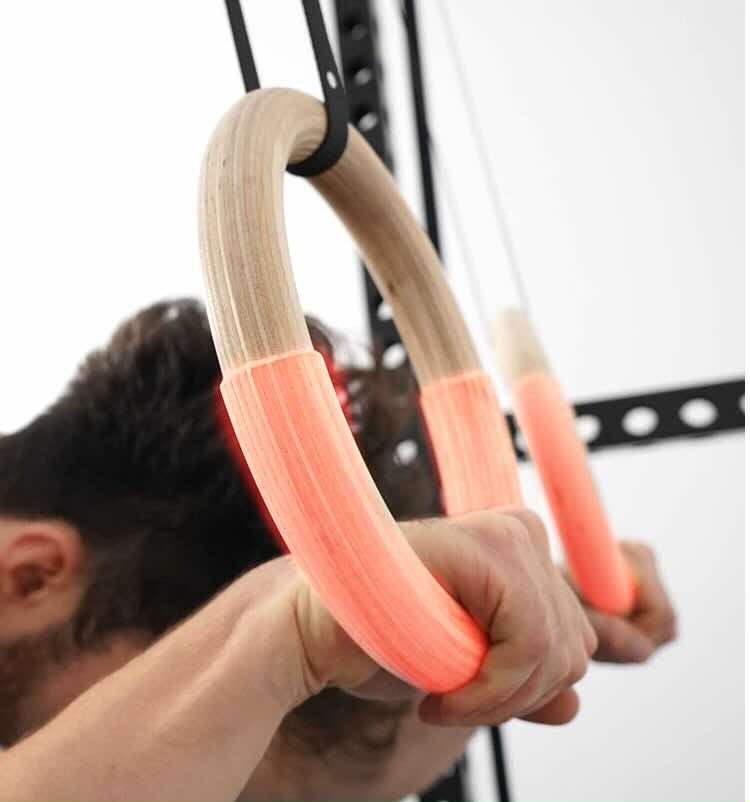
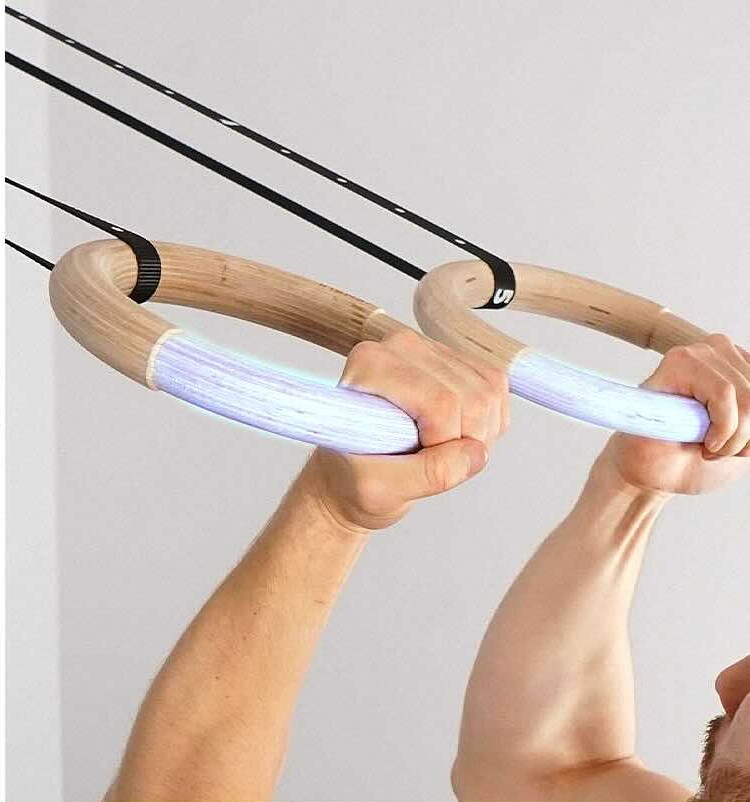
So that is the flaw. One ring, one thickness, one number, and whichever one arrived in the box is now doing your pull-ups, your dips, your rows, your L sits and the muscle-up you are still chasing. You are stuck with it. Except for the chalk mark. If your hand only ever occupies one arc of the loop, then the opposite arc is free. So what if one ring carried both numbers?
The Other Half Of The Circle
The DUO-Rings are a birch ring machined at two thicknesses. Roughly a third of the circumference is 32 millimetres and the rest is 28. Your hand takes the arc at the bottom, the strap takes the arc at the top, and when you want the other number you roll the ring through 180 degrees. It takes under a second and there is no hardware to undo.

The rings in this story
Kensui DUO-Rings, birch, 28 millimetres on one arc and 32 on the other, with 16 foot numbered straps and a travel bag in the box.
Get the DUO-Rings$49 a pair • 4.55 from 163 reviews • 100 day money back trial
Hanging work goes on the 28 arc, so the fingers meet and the forearm lasts. Dips, push-ups and L sits go on the 32 arc, so the wood sits wide and flat in the heel of the hand. Both jobs, one piece of wood, and the number is picked between exercises instead of once at checkout.
Why Nobody Did This For 215 Years
Said out loud, the idea is almost irritating. Nothing about hanging a body from a wooden circle requires the circle to be uniform. The person who said it out loud is Remy Mock, who holds two engineering degrees from MIT and runs Kensui. It is the same move he has made on a dumbbell and on a weight vest. Find the constraint everyone has been designing around, work out whether it is a law or a habit, and if it turns out to be a habit, delete it.
What the loop has to do
- Take a falling bodyweight without splitting
- Stay open enough to pass a hand through
- Carry a nylon strap without crushing it
What your hand needs it to do
- Close down small when you hang, so the fingers meet and the forearm lasts
- Sit wide and flat when you press, so the wood stops rolling in the heel of the hand

A fix this simple invites one fair question, which is why it took two centuries. The answer is that the constraint was never a law. It was a habit older than the sport, and a lathe is simpler that way.
Gymnastic rings are the invention of Friedrich Ludwig Jahn, a Berlin schoolmaster who opened his first gymnastics club in 1811 and equipped it himself. Britannica credits him with the parallel bars, the balance beam, the pommel horse, the horizontal bar and the rings, all of which, in its words, became standard equipment for gymnastics. What he made was a wooden hoop on a rope.
That the shape survived is not the surprising part. The shape is correct in the way a wheel is correct. What survived alongside it is a manufacturing habit nobody has revisited, which is that the hoop gets turned to one diameter all the way around.
That habit is now written into the rulebook. The FIG norm opens its description of the apparatus by specifying that the rings have a uniform, circular profile. Every dimension in that document was pinned down more than a century after Jahn, and several have been adjusted since. Uniformity never has been.
Two hundred and fifteen years of equipment design, and the one decision that governs how the thing feels in your hand was made before anybody wrote it down.
Gymnasts Solved This By Owning Two Of Everything
If you want proof that the two-thickness problem is real, look at who never complains about it, and at what it costs them not to.
Ask a competitive gymnast about ring thickness and the question does not really land. They train on 28 millimetres because the rulebook says 28 millimetres, and they have done since they were nine years old.
Their training hall also owns everything twice. There is a high rig for hanging work and a low set for support work, a chalk bowl, a bar of grips, and a coach who resets the height between exercises. A single thickness is not much of a compromise when the rest of the building absorbs it.
You do not have that hall. What you have is one set of rings, one anchor point and forty minutes, and the second thickness has to come out of the same loop. Rolling the ring half a turn is the forty-minute version of the second rig.

Pick A Number. You Already Did.
If you own rings, you are already on one side of this table. The question is only whether anybody told you.
| A 28mm set | A 32mm set | DUO-Rings | |
|---|---|---|---|
| Grip thicknesses on hand | 28mm only | 32mm only | 28mm and 32mm |
| Matches the FIG competition profile | Yes | No | Yes, on one arc |
| Sized for pressing work (dips, push-ups, L sits) | Compromised | Yes | Yes, on the other arc |
| Getting the second thickness | Buy a second set | Buy a second set | Roll the ring half a turn |
| Time that takes | An order and a wait | An order and a wait | Under a second |
| If you genuinely only ever hang, or only ever press | Nothing wasted | Nothing wasted | You paid for an arc you will not use |
DUO-Rings price, materials and dimensions verified on kensui.com on 9 October 2026. Competition profile from the FIG Apparatus Norms, MAG 3. The last row is the honest one. A single thickness is not a defect if your training only ever asks for the thickness you bought.

What Rotating A Ring Does Not Fix
Three things, in the interest of not overselling a piece of wood.
It does not make the change free. You have to stop, take a hand off, roll the ring and get back on. Between exercises that is nothing. Mid-set it is not available to you, so a workout that wants to alternate thicknesses every thirty seconds is not what this solves.
Weatherproofing is not part of the deal either. Birch is birch. Kensui rates the set at 1,200 lb and the whole kit weighs 1.9 lb with the straps, which does make it a genuinely portable set to throw in a bag, but a pair left out on a park frame through a wet week will age exactly as badly as any other wooden ring.
Last, and most important, thickness will not make you better at rings. It changes how a movement feels and how long your forearms last. It does not build a muscle-up. If your dips are sliding because your elbows are flaring out, no arc of any diameter is going to fix that, and it is worth ruling that out before you buy anything at all.
