SLEEP · 7 MIN READ
Poor Sleep Is Making You Fat
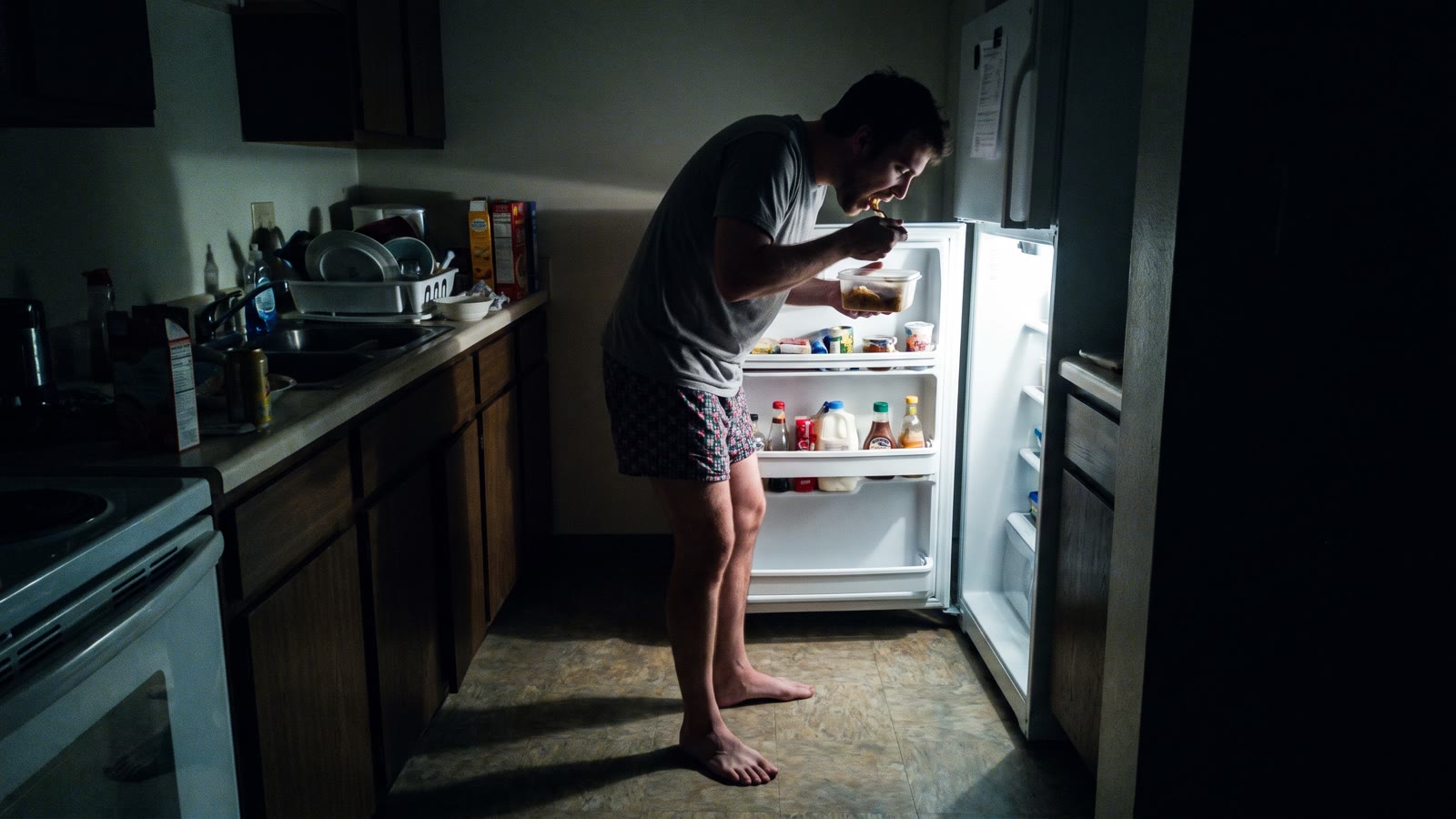
Cut your sleep to five hours and the extra calories arrive after dinner. Cut your calories as well and the weight still comes off, but most of it stops being fat.

The Claim
The plan is always the same. Train hard, eat well, and buy the extra hours from somewhere. Sleep is the easiest place to borrow from, because nothing obvious goes wrong the next morning. You still lift. You still hit your protein. The scale still moves.
That last part is what makes this hard to notice. Sleep is not a recovery bonus you collect in a good week. It changes what your body does with the food you eat and with the tissue you already have, and the scale is the last place that shows up.
Two separate lines of research say so, and they say slightly different things. One looks at short sleep when food is freely available. The other looks at short sleep while dieting. The first says you gain. The second says you lose the wrong thing.
What Happens When Food Is Easy
In 2013 a team at the University of Colorado kept 16 healthy young adults in a lab for just over two weeks.[1] Everyone did a five-day block on nine hours in bed and a five-day block on five. Meals and snacks came on a schedule, but portions did not. People ate as much as they wanted.
Short sleep made them burn more, not less. Total daily energy expenditure rose about 5 percent, which stands to reason, because being awake costs something. The trouble was on the other side of the ledger. Intake climbed faster than expenditure, and most of the extra landed at night, after dinner was already over.
Five days of that added 0.82 kg, near enough to 1.8 pounds, in under a week. When the same people went back to a normal schedule, their intake dropped again and the weight came off.
The researchers read this generously, and they are right to. Eating more on less sleep is not a character flaw. It is your body paying for hours you spend awake. It turns into fat gain because the food is sitting right there, so you take more than those hours actually cost.
And When You Are Already Dieting
Now change one thing. Keep the short nights and take the free food away.
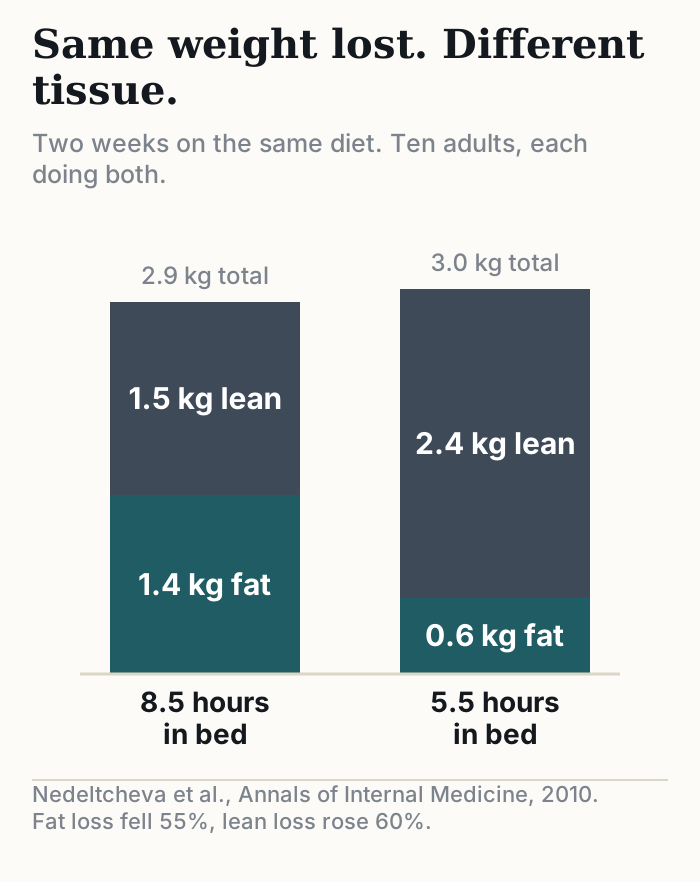
That is the 2010 study every reel on this subject cites.[2] Ten overweight adults, average age 41, spent two weeks on a reduced-calorie diet with 8.5 hours in bed each night, then another two weeks on the same diet with 5.5 hours. The same ten people did both, in random order, which is a stronger test than comparing two separate groups.
Both times they lost about 3 kg. The scale did not care how they had slept.
Everything underneath it did. On 8.5 hours they lost 1.4 kg of fat and 1.5 kg of fat-free mass. On 5.5 hours they lost 0.6 kg of fat and 2.4 kg of fat-free mass. The share of the loss that came from fat fell by 55 percent, and the fat-free loss rose by 60 percent.
Sit with that a moment. Same diet, same fortnight, same three kilos gone. One version came mostly off the fat. The other came mostly off everything else.
Why the Body Picks the Wrong Fuel
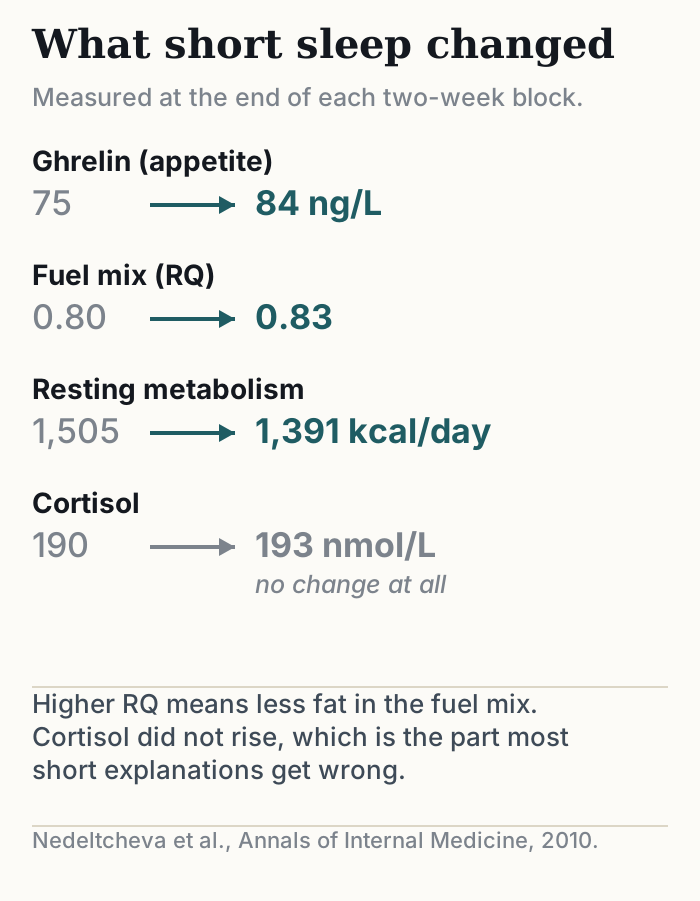
The 2010 team measured what shifted. Hunger rose. So did ghrelin, the hormone that drives appetite, from 75 to 84 ng/L. Resting metabolic rate fell, from roughly 1,505 to 1,391 calories a day.
The clearest signal was in the fuel mix itself. Respiratory quotient, which tracks what the body is burning, rose from 0.80 to 0.83 both fasted and after meals. Higher means less fat in the mix and more carbohydrate and protein.
Their explanation is the interesting part. A brain awake for 19 hours instead of 16 needs glucose for longer, and body protein can be converted into glucose. On short sleep the diet's shortfall got covered less by fat and more by breaking down tissue.
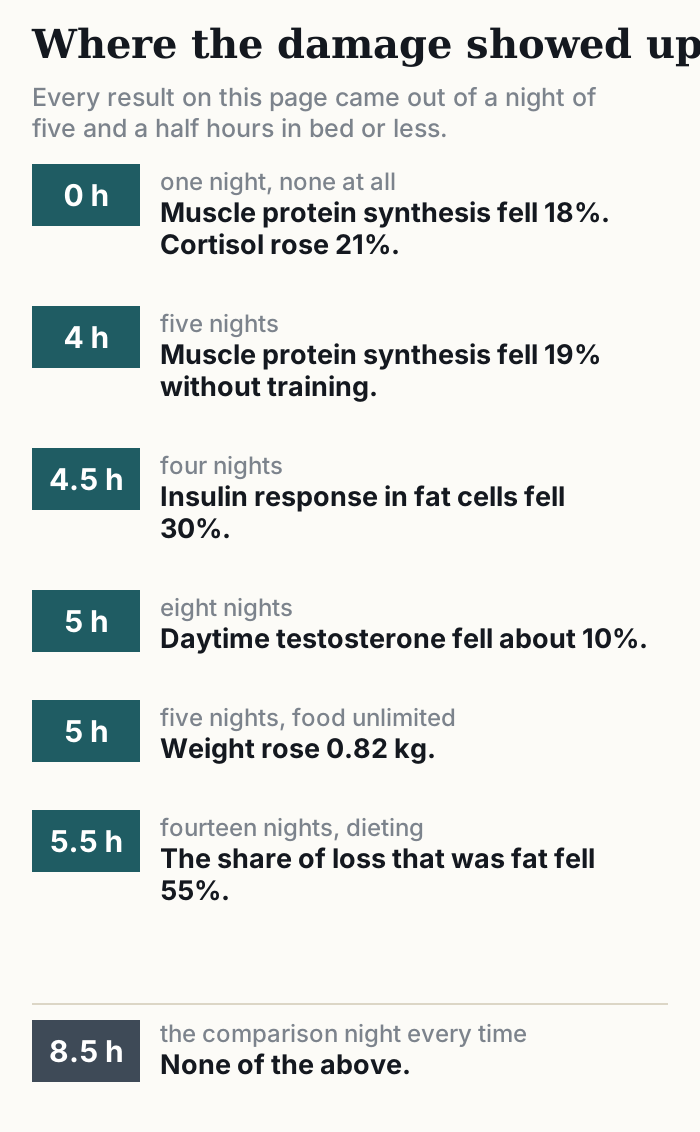
Other work fills in the edges. Four days with 4.5 hours in bed cut insulin sensitivity in fat cells by 30 percent in seven young adults.[3] A week of five-hour nights lowered daytime testosterone by about 10 percent in ten young men.[4] A single night of no sleep at all cut muscle protein synthesis by 18 percent and testosterone by 24 percent in thirteen adults.[5] Every one of those is small on its own. They all point the same way.
What It Looks Like in Practice
The tidy conclusion is that training on short sleep is pointless. The evidence does not say that.
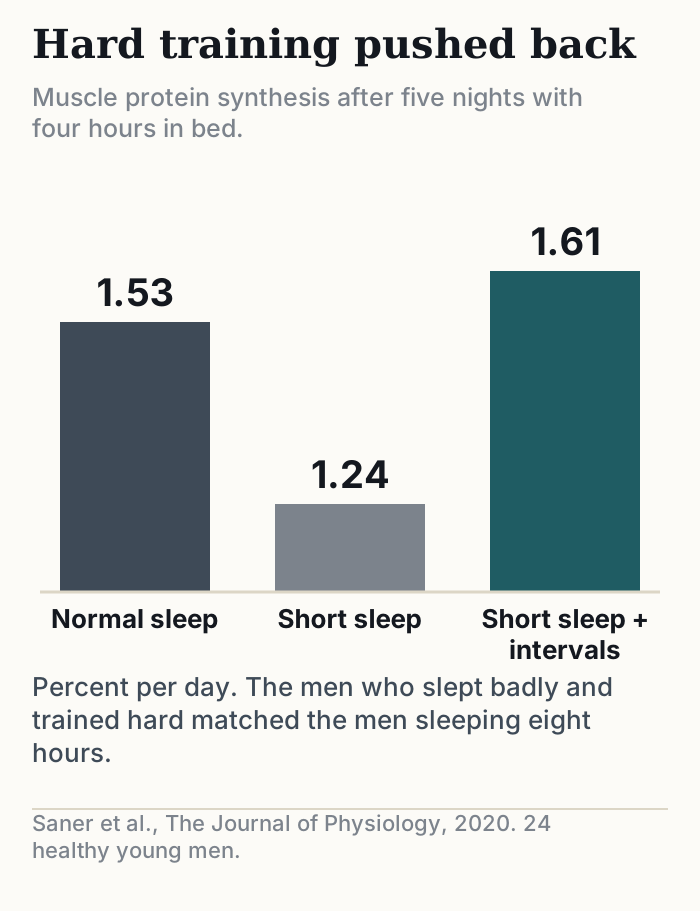
In one trial, 24 young men spent five nights with four hours in bed.[6] One group did nothing else. Another did three high-intensity interval sessions across those nights. Muscle protein synthesis dropped in the group that only slept badly, from 1.53 to 1.24 percent a day. In the group that slept badly and trained hard it was 1.61, no worse than the men getting eight hours.
Training was not what hurt them. The missing sleep was, and hard training pushed back against it.
So the 4 AM alarm is not the villain. The 4 AM is. If a session only exists because you got up before you had finished sleeping, you are paying for it with the tissue you train to keep. A few things follow from that:
- Treat a sleep floor the way you treat a training minimum. The damage in these studies turns up between five and five and a half hours in bed, not at seven.
- Watch the hours after dinner. That is exactly where the extra eating landed in the Colorado study, and it is the easiest place to catch yourself.
- Recovery sleep worked, and quickly. Going back to a normal schedule reversed the intake rise within days.
- If the real choice is a hard session on short sleep or nothing at all, train. It is the fasted 4 AM cardio bought with an hour of sleep that is the bad trade, not exercise.
References
- Markwald RR, Melanson EL, Smith MR, Higgins J, Perreault L, Eckel RH, Wright KP Jr. Impact of insufficient sleep on total daily energy expenditure, food intake, and weight gain. Proc Natl Acad Sci USA. 2013. 110(14), 5695-5700. doi:10.1073/pnas.1216951110
- Nedeltcheva AV, Kilkus JM, Imperial J, Schoeller DA, Penev PD. Insufficient sleep undermines dietary efforts to reduce adiposity. Ann Intern Med. 2010. 153(7), 435-441. doi:10.7326/0003-4819-153-7-201010050-00006
- Broussard JL, Ehrmann DA, Van Cauter E, Tasali E, Brady MJ. Impaired insulin signaling in human adipocytes after experimental sleep restriction: a randomized, crossover study. Ann Intern Med. 2012. 157(8), 549-557. doi:10.7326/0003-4819-157-8-201210160-00005
- Leproult R, Van Cauter E. Effect of 1 week of sleep restriction on testosterone levels in young healthy men. JAMA. 2011. 305(21), 2173-2174. doi:10.1001/jama.2011.710
- Lamon S, Morabito A, Arentson-Lantz E, Knowles O, Vincent GE, Condo D, Alexander SE, Garnham A, Paddon-Jones D, Aisbett B. The effect of acute sleep deprivation on skeletal muscle protein synthesis and the hormonal environment. Physiol Rep. 2021. 9(1), e14660. doi:10.14814/phy2.14660
- Saner NJ, Lee MJ, Pitchford NW, Kuang J, Roach GD, Garnham A, Stokes T, Phillips SM, Bishop DJ, Bartlett JD. The effect of sleep restriction, with or without high-intensity interval exercise, on myofibrillar protein synthesis in healthy young men. J Physiol. 2020. 598(8), 1523-1536. doi:10.1113/JP278828