Science · 6 min read
You Don't Have Bad Calf Genetics. Your Workout Is Just Missing This 2-Second Fix.
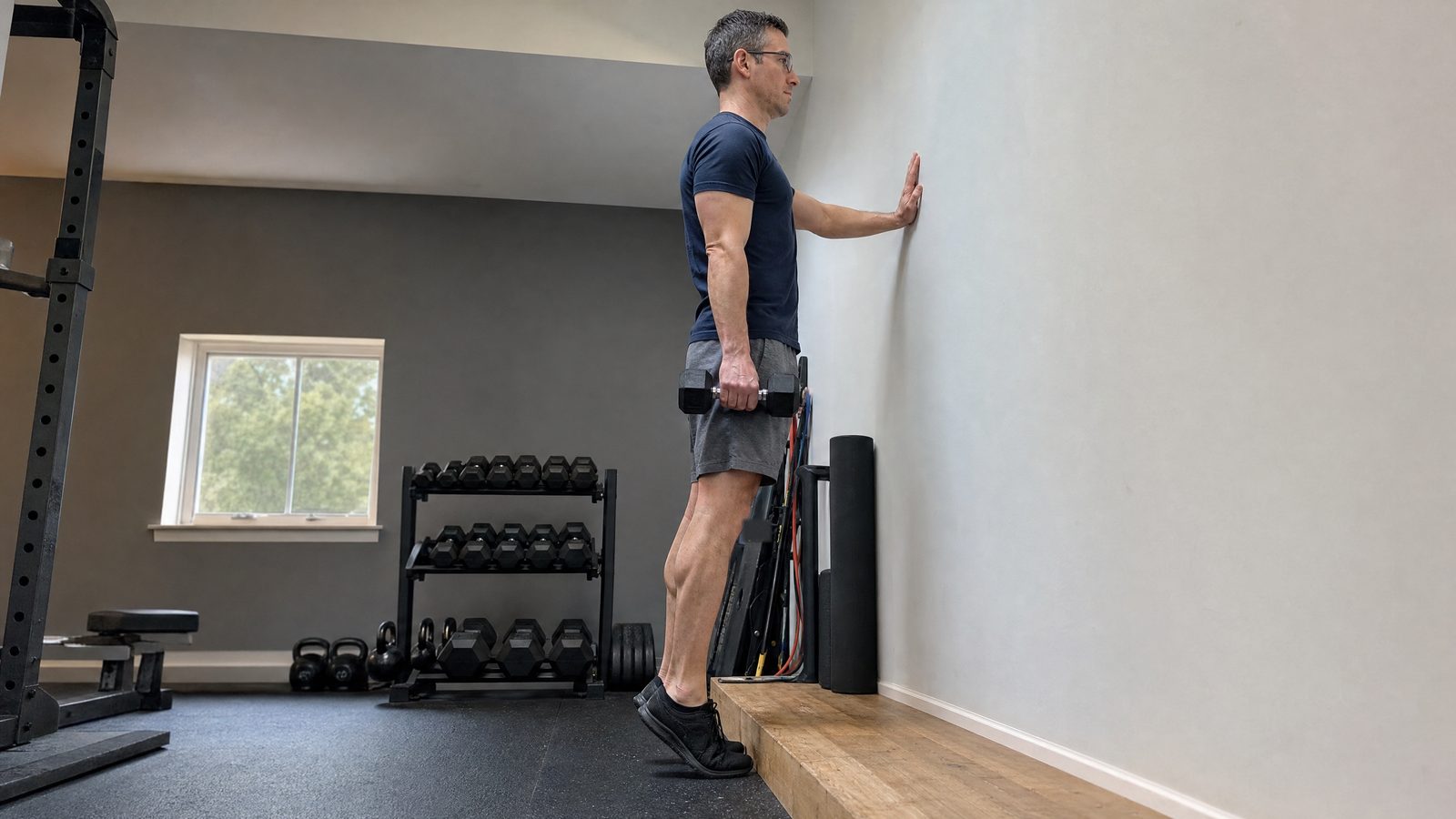
Calves grow slowly in the lab too. But in the best calf studies the fix was never the rep range. It was where you stop the rep, and how long you stay there.
The Claim
You know the set. Leg day is almost over. You load the calf raise machine heavy, knock out ten fast reps, feel the burn, and move on. You have done that for years. Your calves look the same as they did in high school. At some point you decided it was genetics and stopped caring.
The reel says the muscle was never the problem. The bulk of your lower leg is the soleus, a muscle that is around 80 percent slow-twitch fiber. It was built to carry you around all day without getting tired. When you bounce a heavy calf raise, the reel argues, your Achilles tendon catches the weight like a spring and throws it back up. The muscle barely works. The fix is to control the way down, stop at the bottom, and hold it for two full seconds before you push.
The research backs the core of it, and some of it is even stronger than it sounds.
What the Research Actually Found
Start with the fiber claim, because it is true and it is also the wrong lesson. An autopsy study of 36 human muscles put the soleus at roughly 80 to 90 percent slow-twitch fiber, about as slow as human muscle gets.[1] The gastrocnemius, the two-headed muscle on top of it, is closer to half and half.
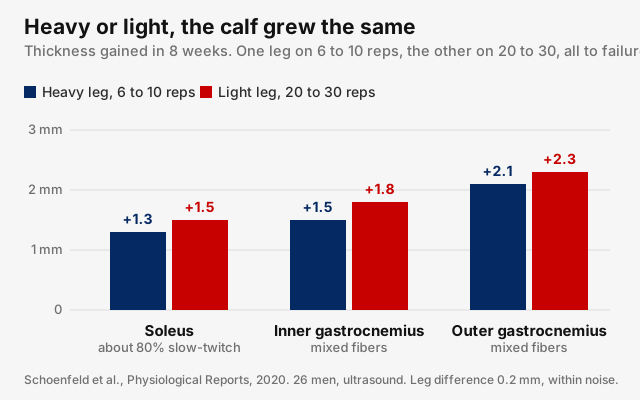
The old gym logic says slow fibers need high reps. A 2020 trial tested exactly that on calves. Twenty-six untrained men trained one leg with heavy sets of 6 to 10 reps and the other with light sets of 20 to 30. Every set went to failure, twice a week for eight weeks. The soleus grew 7.8 percent on both legs. The medial gastrocnemius grew 8.9 percent and the lateral head 13.7 percent, again with no difference between the heavy leg and the light leg.[2] We took that trial apart in our fiber-type explainer. That matches a meta-analysis of 21 studies across the whole body: load does not decide muscle growth when sets go to failure.[3]
So heavy sets are not useless for calves. Fast sets are. And that comes down to the tendon.
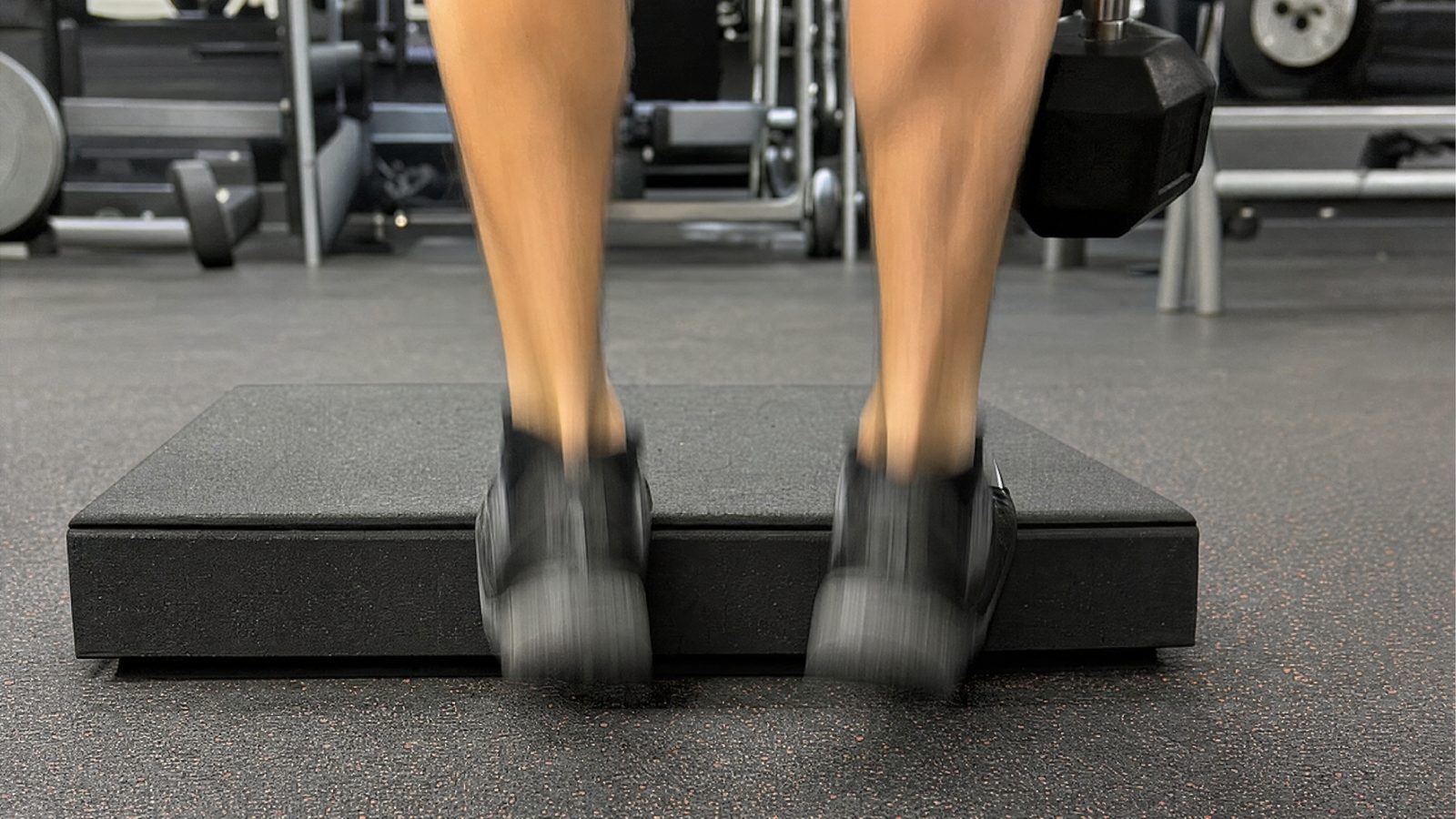
The Achilles is the biggest spring in your body. Researchers in Tokyo put an ultrasound probe on the calf of six men while they walked on a treadmill. The muscle fibers barely changed length during the step, holding at about 50 millimeters. The tendon did the moving: it stretched about 7 millimeters as the body rolled over the foot, then snapped back at push-off.[4] A London group measured the same thing during one-legged hopping. The tendon stretched 8.3 percent. Its recoil returned 38 of the 254 joules of work in each hop, about one rep in six done by rubber rather than muscle.[5]
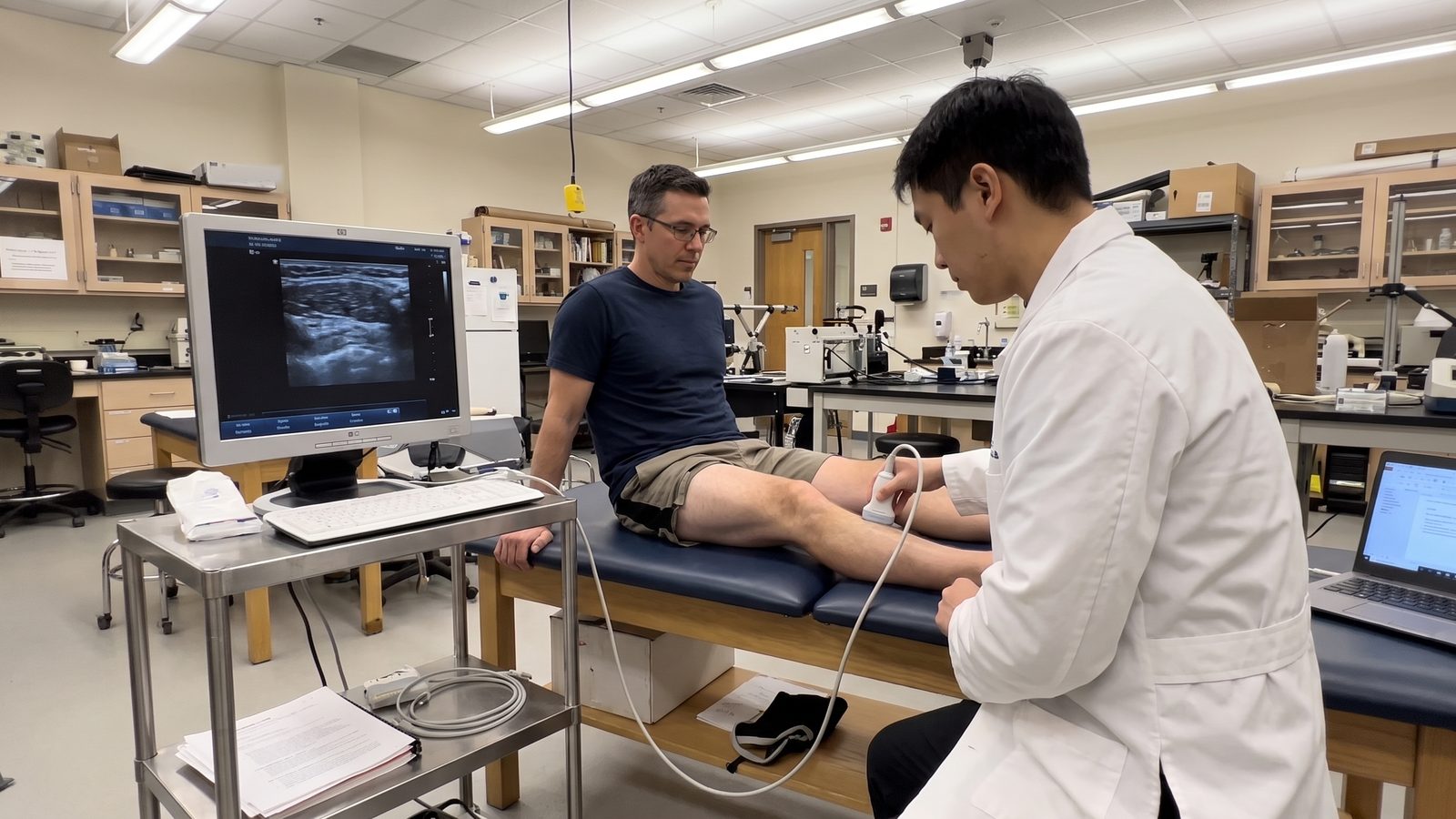
A bounced calf raise is a hop with a barbell on your back. The heel drops, the tendon loads, and you ride the recoil back to the top.
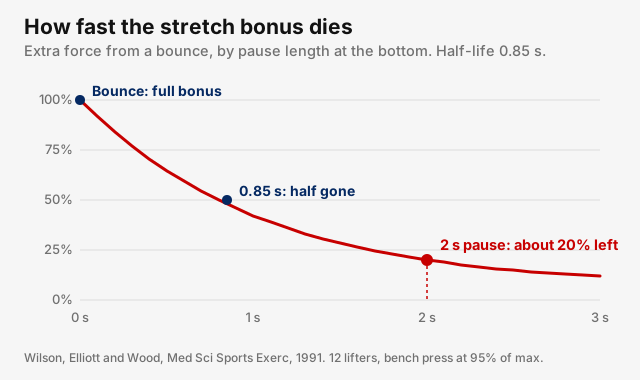
The pause is what breaks that. In 1991 a team in Western Australia had 12 experienced lifters bench press at 95 percent of their max. Some reps bounced off the chest. Others paused at the bottom for different lengths of time. The extra force from the stretch faded with a half-life of 0.85 seconds.[6] Run that out and a two-second pause leaves about one fifth of the bonus. By then the rep is almost entirely muscle.
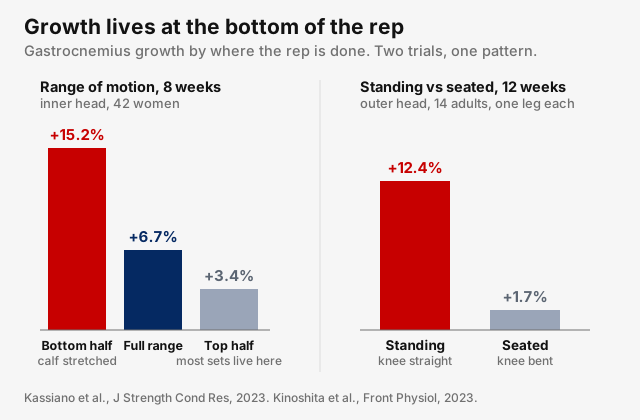
Where you stop matters as much as how long. In a 2023 trial, 42 young women trained calf raises for eight weeks in one of three ranges. One group did the full movement. One did only the bottom half, with the calf stretched. One did only the top half. The stretched half grew the medial gastrocnemius 15.2 percent. The full range managed 6.7 percent. The top half, the part where most people spend the whole set, managed 3.4 percent.[7] A Japanese team found the same pattern from a different angle. Fourteen adults trained one leg standing, where the gastrocnemius is stretched over a straight knee, and the other leg seated. After 12 weeks the standing leg's lateral gastrocnemius grew 12.4 percent against 1.7 percent seated. The medial head grew 9.2 percent against 0.6.[8]
What It Looks Like in Practice
Put those studies together and you get one calf raise, not a new program.
The 2-second calf raise
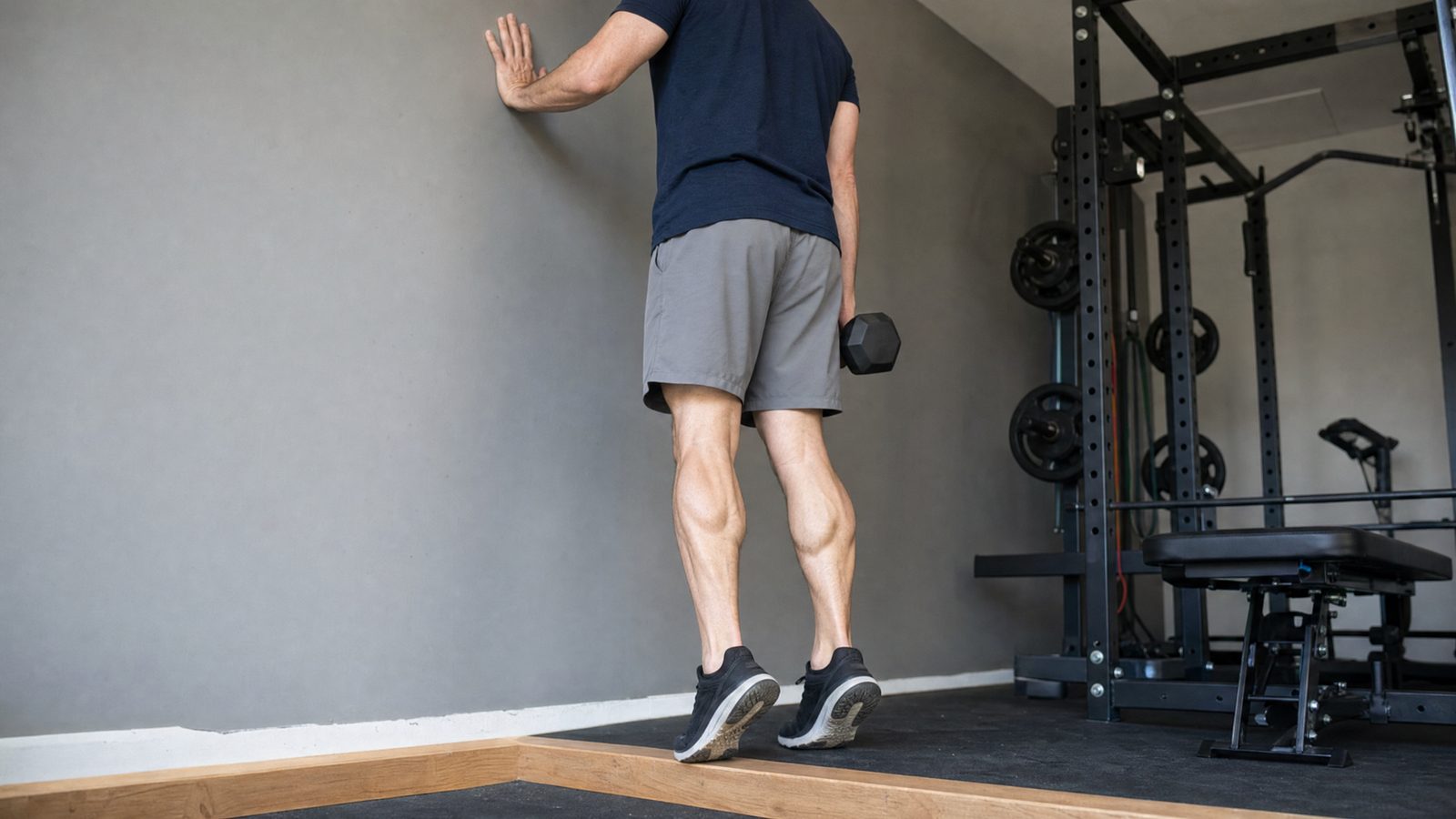
- Stand, do not sit. Knees straight, balls of the feet on a step edge so the heel can drop.
- Lower for three seconds to a full stretch. That bottom half is where the growth was measured.
- Stop and count two full seconds. No dip, no bounce. This is the whole fix.
- Drive up hard, squeeze for a beat at the top, repeat.
- Any load that reaches failure between 6 and 30 reps. The pause will cut the weight you can use. That is the point.
- Three sets, two or three days a week, for eight weeks before you judge it. That was the dose in every trial above.
Seated calf raises still have a job. They take the gastrocnemius out and let you add soleus volume with a lighter load. They are just not where the visible calf comes from. One more detail from the same lab in Brazil. Over nine weeks, toes turned out shifted growth to the inner head. Toes turned in shifted it to the outer head.[9] Toes forward is the default. Use the angle if one head lags.
References
- Johnson MA, Polgar J, Weightman D, Appleton D. Data on the distribution of fibre types in thirty-six human muscles. An autopsy study. J Neurol Sci. 1973;18(1):111-129. doi:10.1016/0022-510x(73)90023-3
- Schoenfeld BJ, Vigotsky AD, Grgic J, et al. Do the anatomical and physiological properties of a muscle determine its adaptive response to different loading protocols? Physiol Rep. 2020;8(9):e14427. doi:10.14814/phy2.14427
- Schoenfeld BJ, Grgic J, Ogborn D, Krieger JW. Strength and hypertrophy adaptations between low- vs. high-load resistance training: a systematic review and meta-analysis. J Strength Cond Res. 2017;31(12):3508-3523. doi:10.1519/JSC.0000000000002200
- Fukunaga T, Kubo K, Kawakami Y, Fukashiro S, Kanehisa H, Maganaris CN. In vivo behaviour of human muscle tendon during walking. Proc Biol Sci. 2001;268(1464):229-233. doi:10.1098/rspb.2000.1361
- Lichtwark GA, Wilson AM. In vivo mechanical properties of the human Achilles tendon during one-legged hopping. J Exp Biol. 2005;208(24):4715-4725. doi:10.1242/jeb.01950
- Wilson GJ, Elliott BC, Wood GA. The effect on performance of imposing a delay during a stretch-shorten cycle movement. Med Sci Sports Exerc. 1991;23(3):364-370. PMID 2020276
- Kassiano W, Costa B, Kunevaliki G, et al. Greater gastrocnemius muscle hypertrophy after partial range of motion training performed at long muscle lengths. J Strength Cond Res. 2023;37(9):1746-1753. doi:10.1519/JSC.0000000000004460
- Kinoshita M, Maeo S, Kobayashi Y, et al. Triceps surae muscle hypertrophy is greater after standing versus seated calf-raise training. Front Physiol. 2023;14:1272106. doi:10.3389/fphys.2023.1272106
- Nunes JP, Costa BDV, Kassiano W, et al. Different foot positioning during calf training to induce portion-specific gastrocnemius muscle hypertrophy. J Strength Cond Res. 2020;34(8):2347-2351. doi:10.1519/JSC.0000000000003674
- Trappe TA, Raue U, Tesch PA. Human soleus muscle protein synthesis following resistance exercise. Acta Physiol Scand. 2004;182(2):189-196. doi:10.1111/j.1365-201X.2004.01348.x