You Can't Spot-Reduce Fat. You Can Spot-Build Muscle. Here's the Proof, and the Catch. | Science Meets Gym

Science · 6 min read

You Can't Spot-Reduce Fat. You Can Spot-Build Muscle. Here's the Proof, and the Catch.
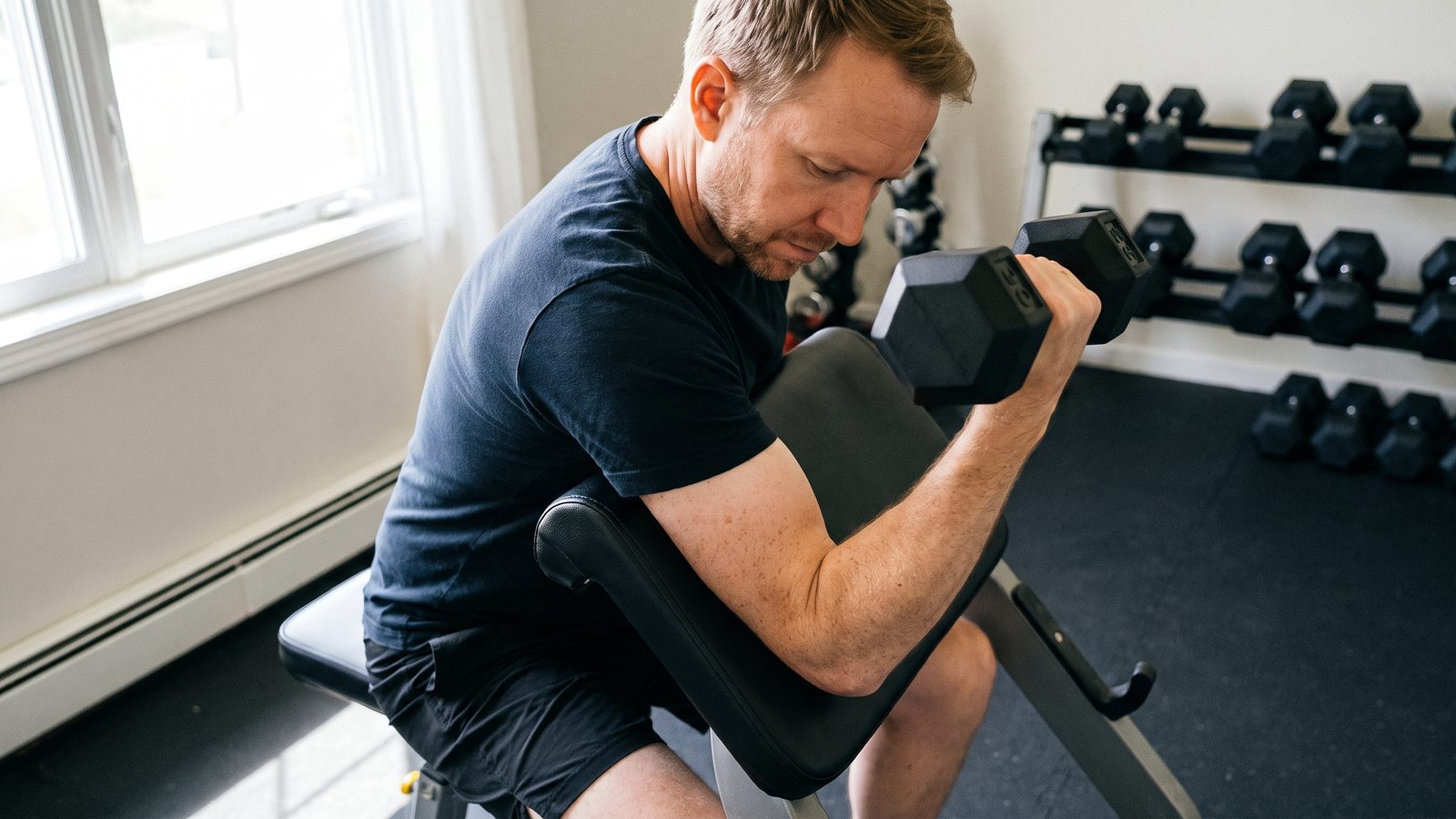
A man in a navy t-shirt seated at a preacher curl bench in a home gym, upper arm on the angled pad, curling a black hex dumbbell and looking down at his own biceps, a rack of dumbbells behind him

Thirty years of MRI scans agree that a muscle grows where an exercise makes it work, not evenly from end to end, and that switching the exercise moves the growth. The open question is the biceps: the trials that tested it have not found the effect yet.

The Claim

You have probably tried the fat half of this already. A few hundred crunches a week for the belly. The inner-thigh machine at the end of every leg day. It did nothing, and by now most people know why. Fat comes off the whole body, in an order your genes decide.

The muscle half is the newer idea, and it is the reel's point. A muscle does not grow evenly from end to end. Change the angle or the position of an exercise and you change where it grows most. So if the top of your biceps or the outer sweep of your thigh lags, the fix is not more sets of the same movement. It is a different movement.

The classic example is the biceps. An incline curl for the upper part near the shoulder, the idea goes, and a preacher curl for the lower part near the elbow.

One of those two ideas is settled science. The other is not, and it is the one with the biceps in it. Take them in order.

What the Research Actually Found

Spot reduction has been tested hard, and it fails every time it is measured properly. In a 2013 trial, 11 adults trained one leg for 12 weeks, three times a week, with 960 to 1,200 leg-press reps a session at a light load. Their body fat fell 5 percent. It came off the arms, down 10.2 percent, and the trunk, down 6.9 percent. The trained leg lost no more fat than the untrained one.[1] A larger study had 104 people train one arm for 12 weeks. On MRI, the trained arm shed no more fat than the other one.[2]
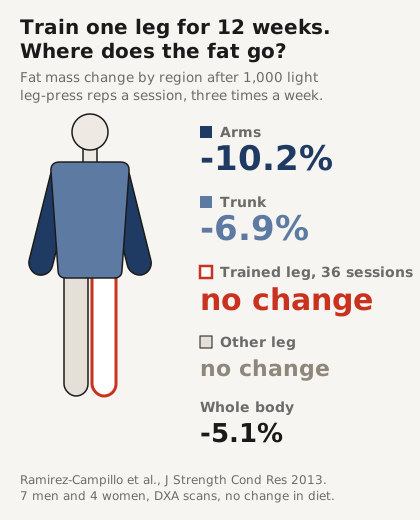
Infographic of a body outline from the 2013 one-leg trial: the arms shaded darkest at minus 10.2 percent fat, the trunk minus 6.9 percent, the trained leg outlined in red with no change, the other leg no change, whole body minus 5.1 percent

Muscle behaves differently, and the evidence is old. In 1992, MRI scans of 13 men after eight weeks of training showed growth that differed from muscle to muscle and from one level of a muscle to the next.[3] In 1996, seven men trained leg extensions for six months. Their quads grew about 19 percent at the top and bottom of the thigh, but only 13 percent in the middle.[4] A muscle does not inflate like a balloon. It grows in patches.

The real question was whether you can steer the patches. A lab at Waseda University in Tokyo answered it in two studies that are the backbone of this article. In the first, 12 men did one session of lying triceps extensions: five sets of eight with a dumbbell at 80 percent of their max. An MRI taken minutes later showed which parts of the triceps had just worked. Another 12 men then trained the same exercise three times a week for 12 weeks. The region that lit up least after the single session, the part near the elbow, was also the region that grew least over 12 weeks.[5] In the second study, 12 men trained a bench press for 12 weeks. This time the middle of the triceps lit up more and grew more, and the top of the muscle near the shoulder lagged.[6] Same muscle, two exercises, two growth maps, and each map was visible after one workout.
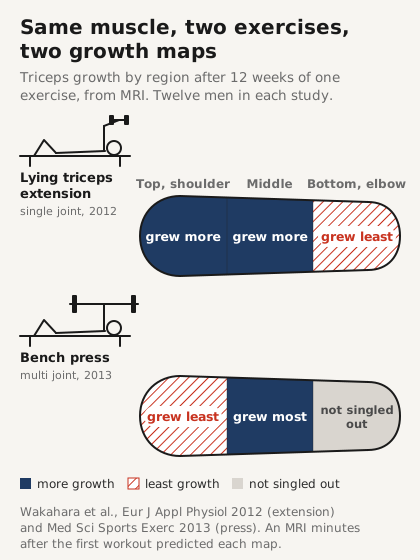
Infographic of two upper-arm outlines split into top, middle and bottom regions, with a pictogram of each exercise above: after lying triceps extensions the top and middle grew more and the bottom near the elbow grew least, after a bench press the middle grew most and the top near the shoulder grew least

The same lab repeated the trick on the thigh in 2017. The part of the rectus femoris that activated most in the first knee-extension session was the part that grew most over 12 weeks.[7]

Exercise choice can even change a muscle's shape. In 2023, 12 people trained one leg with single-leg knee extensions and the other with single-leg squats for eight weeks. Total quad growth was the same on both legs. On the knee-extension leg, though, the muscle's center of mass moved 2.4 centimeters, almost an inch, toward the knee. On the squat leg it stayed put.[8] Another trial, with volume and intensity matched, found that leg extensions grew all three regions of the rectus femoris while Smith-machine squats grew only the middle of the vastus lateralis.[9]
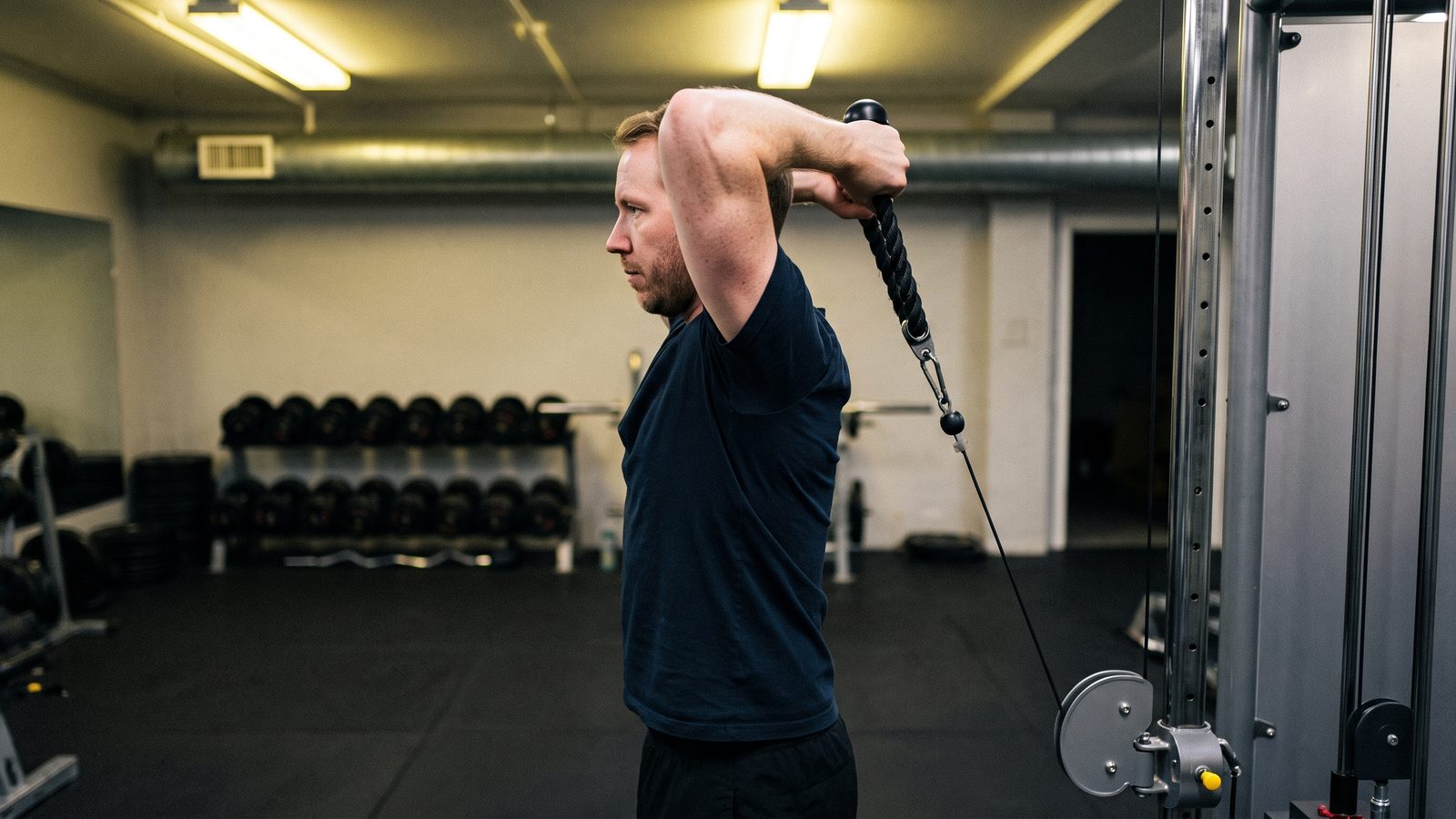
Side view of a man in a navy t-shirt in a gym doing an overhead cable triceps extension, both upper arms pointing up beside his head, a rope attachment held behind his head and the cable running down behind his back to a low pulley

Arm position matters most for a muscle that crosses two joints. In 2023, 21 adults trained cable triceps extensions for 12 weeks, one arm overhead and the other at the side. The overhead arm lifted 34 to 39 percent less weight and grew more anyway. Its long head, the one that crosses the shoulder, gained 28.5 percent in volume against 19.6 percent, 1.5 times as much. The whole triceps gained 19.9 percent against 13.9.[10]
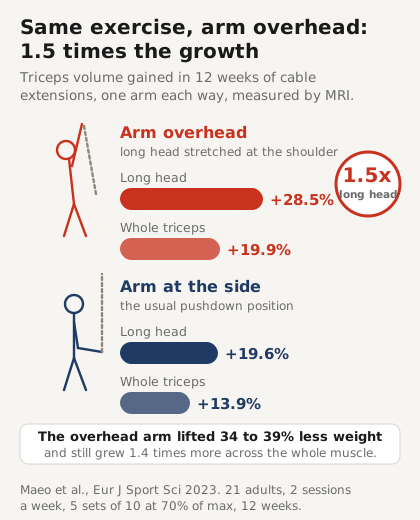
Infographic with a stick figure doing a cable extension overhead and one at the side, and growth bars for each: long head up 28.5 percent overhead against 19.6 at the side, whole triceps 19.9 against 13.9, a 1.5x badge, and a note that the overhead arm lifted 34 to 39 percent less weight

So the core of the reel is right. A muscle grows where an exercise makes it work. That place moves when the exercise changes. And you can see it on a scan.

What It Looks Like in Practice

Three rules fall out of those studies.

  1. If a region lags, change the exercise, not the weight. One session's activation map predicted 12 weeks of growth. If you have done the same press for two years and the top of your triceps has not moved, more weight on that press is unlikely to fix it. A different movement might.
  2. Train the stretched position when you can. Overhead extensions beat the same movement at the side by half again, with less weight.[10] On the biceps, preacher curls done in the stretched half of the movement grew the lower biceps more than the top half did,[11] and five weeks of curls in the extended range grew the elbow flexors 8.9 percent against 3.4 percent for the flexed range.[12]
  3. Pick two exercises per muscle that load it differently, not five that load it the same. A single-joint extension and a press for the triceps. A stretched curl and a squeeze curl for the biceps. A squat and a leg extension for the quads. That covers the regions the scans found.
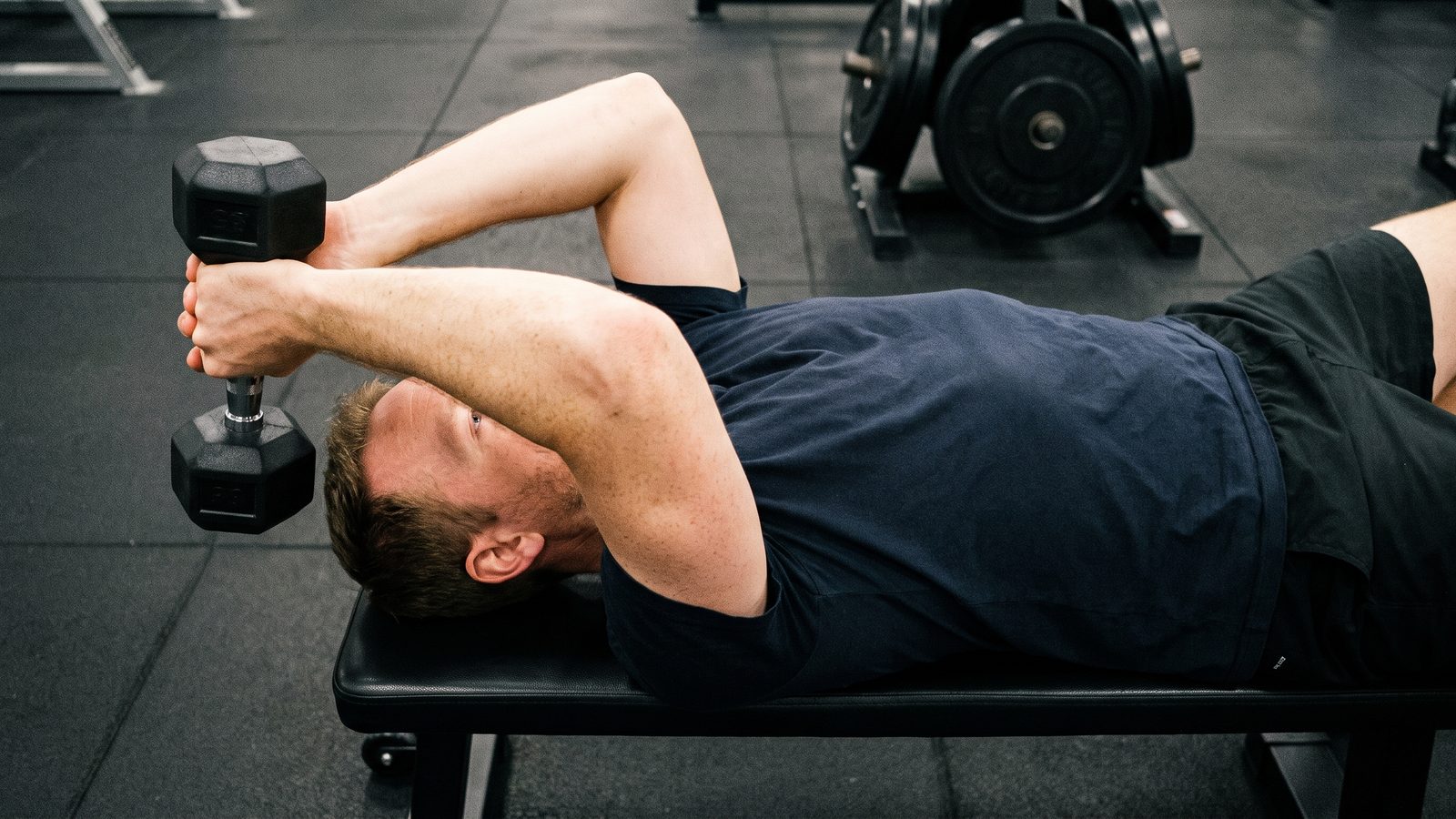
A man in a navy t-shirt lying on a flat bench in a gym, holding a black hex dumbbell in both hands behind his head with his elbows pointing up, at the bottom of a lying triceps extension, a plate tree out of focus behind him
Read more Toes in or toes out steers which calf head grows. The other calf fix is a two-second pause.

References

  1. Ramírez-Campillo R, Andrade DC, Campos-Jara C, Henríquez-Olguín C, Alvarez-Lepín C, Izquierdo M. Regional fat changes induced by localized muscle endurance resistance training. J Strength Cond Res. 2013;27(8):2219-2224. doi:10.1519/JSC.0b013e31827e8681
  2. Kostek MA, Pescatello LS, Seip RL, et al. Subcutaneous fat alterations resulting from an upper-body resistance training program. Med Sci Sports Exerc. 2007;39(7):1177-1185. doi:10.1249/mss.0b0138058a5cb
  3. Housh DJ, Housh TJ, Johnson GO, Chu WK. Hypertrophic response to unilateral concentric isokinetic resistance training. J Appl Physiol. 1992;73(1):65-70. doi:10.1152/jappl.1992.73.1.65
  4. Narici MV, Hoppeler H, Kayser B, et al. Human quadriceps cross-sectional area, torque and neural activation during 6 months strength training. Acta Physiol Scand. 1996;157(2):175-186. doi:10.1046/j.1365-201X.1996.483230000.x
  5. Wakahara T, Miyamoto N, Sugisaki N, et al. Association between regional differences in muscle activation in one session of resistance exercise and in muscle hypertrophy after resistance training. Eur J Appl Physiol. 2012;112(4):1569-1576. doi:10.1007/s00421-011-2121-y
  6. Wakahara T, Fukutani A, Kawakami Y, Yanai T. Nonuniform muscle hypertrophy: its relation to muscle activation in training session. Med Sci Sports Exerc. 2013;45(11):2158-2165. doi:10.1249/MSS.0b013e3182995349
  7. Wakahara T, Ema R, Miyamoto N, Kawakami Y. Inter- and intramuscular differences in training-induced hypertrophy of the quadriceps femoris: association with muscle activation during the first training session. Clin Physiol Funct Imaging. 2017;37(4):405-412. doi:10.1111/cpf.12318
  8. Earp JE, Angelino D, Hatfield DL, et al. Differing hypertrophy patterns from open and closed kinetic chain training affect quadriceps femoris center of mass and moment of inertia. Front Physiol. 2023;14:1074705. doi:10.3389/fphys.2023.1074705
  9. Zabaleta-Korta A, Fernández-Peña E, Torres-Unda J, Garbisu-Hualde A, Santos-Concejero J. The role of exercise selection in regional muscle hypertrophy: a randomized controlled trial. J Sports Sci. 2021;39(20):2298-2304. doi:10.1080/02640414.2021.1929736
  10. Maeo S, Wu Y, Huang M, et al. Triceps brachii hypertrophy is substantially greater after elbow extension training performed in the overhead versus neutral arm position. Eur J Sport Sci. 2023;23(7):1240-1250. doi:10.1080/17461391.2022.2100279
  11. Pedrosa GF, Simões MG, Figueiredo MOC, et al. Training in the initial range of motion promotes greater muscle adaptations than at final in the arm curl. Sports (Basel). 2023;11(2):39. doi:10.3390/sports11020039
  12. Sato S, Yoshida R, Kiyono R, et al. Elbow joint angles in elbow flexor unilateral resistance exercise training determine its effects on muscle strength and thickness of trained and non-trained arms. Front Physiol. 2021;12:734509. doi:10.3389/fphys.2021.734509
  13. Zabaleta-Korta A, Fernández-Peña E, Torres-Unda J, Francés M, Zubillaga A, Santos-Concejero J. Regional hypertrophy: the effect of exercises at long and short muscle lengths in recreationally trained women. J Hum Kinet. 2023;87:259-270. doi:10.5114/jhk/163561
  14. Attarieh P, Nunes JP, Khani S, et al. Comparison between shoulder flexed and extended positions in elbow flexion resistance training on regional hypertrophy and maximum strength: preacher versus Bayesian cable curls. Eur J Sport Sci. 2025;25(4):e12279. doi:10.1002/ejsc.12279
  15. Varovic D, Wolf M, Schoenfeld BJ, Steele J, Grgic J, Mikulic P. Does muscle length influence regional hypertrophy? A systematic review and meta-analysis. Int J Sports Med. 2025;46(14):1027-1036. doi:10.1055/a-2615-4935
  16. Havers T, Wagner N, Held S, Geisler S, Wiewelhove T. Partial range, full gains? The effect of 8 weeks of partial range of motion training at long muscle lengths on elbow flexor hypertrophy and strength in trained individuals. Eur J Sport Sci. 2025;25(12):e70087. doi:10.1002/ejsc.70087
  17. English AW, Wolf SL, Segal RL. Compartmentalization of muscles and their motor nuclei: the partitioning hypothesis. Phys Ther. 1993;73(12):857-867. doi:10.1093/ptj/73.12.857
Chris Bennett

Chris Bennett

Senior writer

Chris Bennett is a house byline for Science Meets Gym. Gear published under it is bought at retail and trained with before anything gets a verdict, and every claim about training outcomes is checked against the published research first.

Read full bio

Science Meets Gym earns a commission when you buy through some of the links on this page. It never changes which products we recommend or how they score.