Neck Training • 8 min read
The $15 Neck Harness Trained One Direction For Two Years. My Neck Got Hurt In The Other Three.
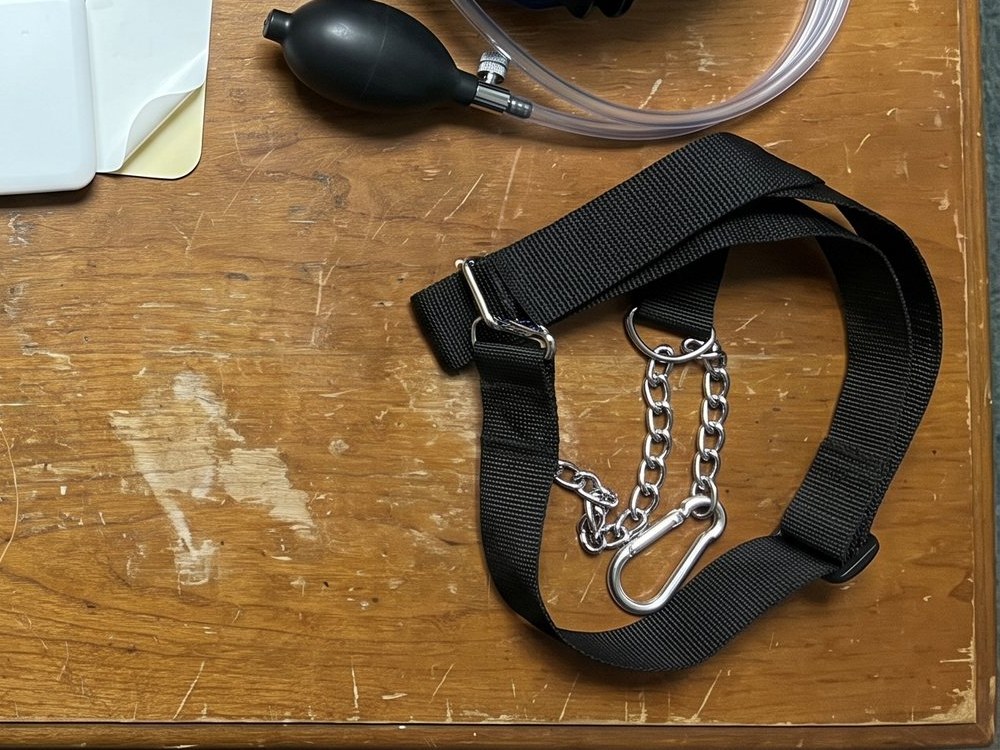
Two years of face down nods on a leather strap built the back of my neck and never once loaded the front or either side. Both times my neck got hurt on the mat, it was bent one of those ways. The same kind of strap sells for $14.99 today. Here is what a hanging plate cannot train, what I priced from $15 to $599, and the one that trains the other three.

Two Years Of Nodding At The Floor
The wrestling room at my high school had a leather head strap hanging on a nail by the door. It had a chain, a clip and one plate that nobody ever took off. The same coach who had us bridging on our heads had us on the strap too, and before long I bought my own for home.
The routine never changed. Face down across the end of my bed, strap on, plate hanging off the chain. Let the chin drop toward the floor, lift the head back up. Three sets of twenty, three nights a week, for two years.
In my second season a guy cranked my head sideways coming out of a scramble, and for a week I could not turn far enough to check my blind spot. The next winter a snap down drove my chin into my chest hard enough that I sat out practice. Sideways, then forward. Neither was the direction I had spent two years training.
I cannot tell you the strap was why. Wrestlers get their necks bent every way a neck can bend, and two tweaks in two seasons is ordinary. What I can tell you is how many directions I had trained, and it was one.
What two years on the strap bought
- Leather strap and chain (the same kind today)$14.99
- Nights on the end of the bedabout 300
- Reps face down, lifting the headabout 18,000
- Reps chin to chest0
- Reps ear to shoulder, either side0
- Reps turning the head0
Directions trained1 of 4
It worked, for what it was. The back of my neck got thick and my traps came up. That part is not a guess. In 1997 a team in Georgia put 22 students on twelve weeks of squats, deadlifts, rows and presses, and eight of them added three sets of ten loaded head extensions. Only those eight grew any neck. The muscle at the back went from 19.5 to 22.0 square centimetres, about 13 percent, and they got about a third stronger.
That study trained one direction and measured one direction, which is exactly what my strap did. What nobody measured, in that lab or in my bedroom, was the other three.
Why A Chain Only Pulls One Way
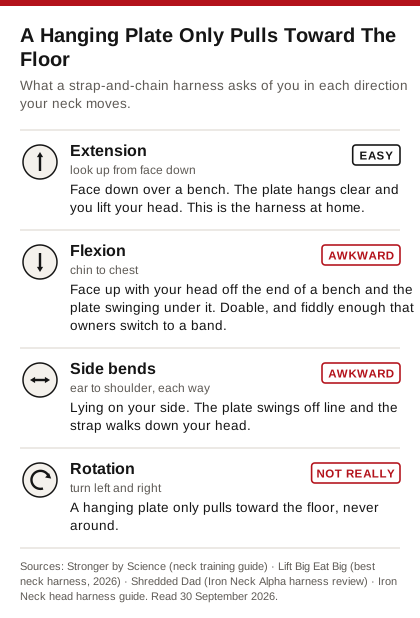
A plate on a chain hangs straight down. Face down, straight down is exactly what you want: you lift your head against it and the back of the neck does the work. Every other direction means lying some other way so that down becomes the direction you are fighting.
Chin to chest means lying face up with your head off the end of a bench and the plate swinging under it. I tried it once, it felt like a bad idea, and I went back to nodding at the floor. Side bends mean lying on your side while the plate swings off line and the strap creeps down your head. Turning your head against a hanging plate is not a thing at all. Gravity pulls down, not around.
Stronger by Science mentions the head harness only for loading extension and calls free weights "not a viable modality to train neck rotation." A 2026 buyer's guide at Lift Big Eat Big is blunter: "Traditional neck harnesses allow one or two movements." Some makers say theirs does side work too, and with enough fiddling you can rig it. In two years I never did, and nobody in that wrestling room did either.
Years later, at a desk job and with a neck that had gone soft, I bought the same tool again: a $35 chain strap from DMoose, rated to 300 pounds. It did the same one thing. It is the strap at the top of this page, and it is still in my desk drawer.
Everything I Priced Next
The morning I finally looked at my neck from the side in the mirror, the back was thick and the front was not.
So I went looking for something that trained the rest of it, and priced it like any other gear, on each maker's own site. Every one of these wins something outright.
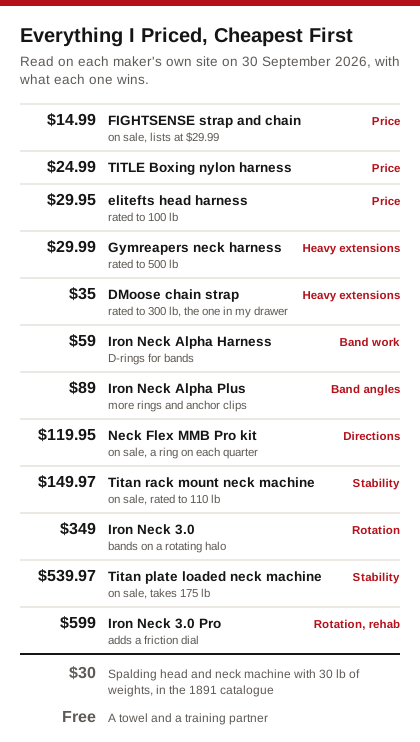
The cheap straps win on price and on hanging heavy weight off the back of your head. Gymreapers rates its $29.99 strap to 500 pounds. They also load the same one direction mine did.
The Iron Neck Alpha and Alpha Plus add D-rings, so you can clip bands at other angles, and they win on band work. A Shredded Dad review says the Alpha "tends to move down a bit" on some exercises, and Garage Gym Reviews lists two cons for the Plus: "Not recommended for over 100 lbs" and "Not designed for rotational neck training." The Neck Flex kit puts a ring on each quarter of the harness and wins on directions among harnesses, but a plate on it still swings.
The Titan machines win on stability, and the first needs a power rack while the second needs a room. The Iron Neck 3.0 and 3.0 Pro are the best things here for rotation and rehab work, and they run on bands, so the smallest step up is the next band.
None of this is a new idea. In 1891 the Spalding gymnasium catalogue sold a head and neck machine, a head strap on a pulley with 30 pounds of weights, for $30. Its engravings showed a man using it facing forward, then facing back, and the text added the sentence I wish somebody had read to me in that wrestling room: "Side movements must also be made to complete the exercise and improve the symmetry of the body."
What A Neck Trainer Has To Load
Before I opened a single product page, I wrote down what the thing had to do. The research of the last few years made the first line easy.
In 2025 the British Journal of Sports Medicine published a panel of 18 international experts who voted on 57 statements about neck training for athletes. 94 percent agreed it should include exercises in all planes, 88 percent listed flexion, extension and side bending, and 94 percent said to add weight over time. The panel's goal was fewer hard knocks to the head in sport, it rated the evidence under all of it as very low certainty, and one author works for a company that sells a neck training device. It is still the closest thing to a rulebook there is.
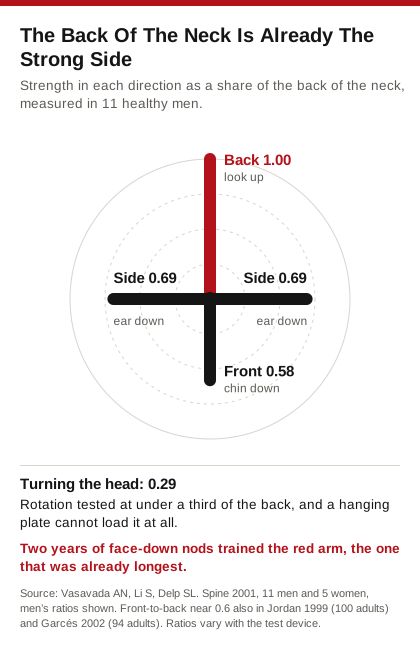
There is a plainer reason to care about the other three. In healthy adults the back of the neck is already the strong side. The front typically tests at somewhere between half and two thirds of the back, and one of the few studies to test every direction put the sides at 0.69 of the back and turning the head at 0.29. Two years on the strap trained the direction that was already strongest.
Injury is where this gets murky. Two studies of schoolboy rugby players found the boys later concussed had relatively weak backs of the neck, the one direction a harness does train, and a 2022 study of 358 athletes found the reverse pattern in rugby players with past concussions. A 2023 review of eight studies and 7,625 athletes found small effects that did not reach significance, and a 2026 review calls the evidence inconclusive. Nothing here says training the front of your neck protects you from anything, and my two tweaks prove nothing either. It says the front, the sides and the turn are muscles too, and a strap never loads them.
So here is the rubric. Anything I bought had to pass all four tests.
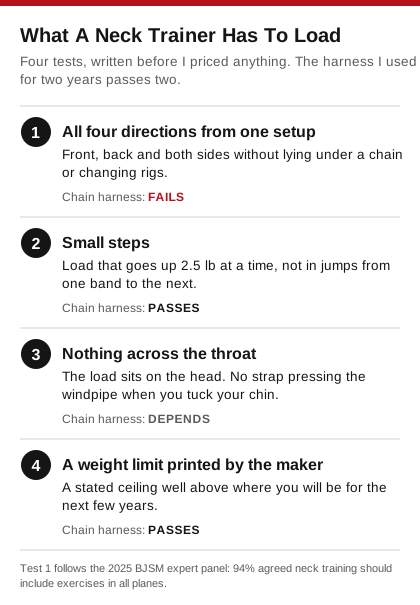
A chain strap passes two of them. Plates come in 2.5 pound steps, and makers print a limit: elitefts says 100 pounds, DMoose 300. It fails the first. The third depends on the strap, and one Alpha Plus owner wrote on Iron Neck's own site that the thin chin strap "pushes in on my Adams' apple."
The One That Loads The Other Three
What passed is a helmet with no top. The Kensui EZ-HELM V2 is a two pound nylon fibreglass frame with a pad at the front and the back of the head, a chin cup, and a threaded sleeve over each ear that takes any 2 inch Olympic plate. Gravity still only pulls down. The difference is that the plates are fixed to your head instead of swinging on a chain, so every way you lie becomes a direction you can train. On your back it loads the front. Face down, the back. On your side, the side that faces up. Nothing hangs off a bench and nothing sits on your face. Kensui rates it to 100 pounds and it costs $199.
The Verdict
Kensui EZ-HELM V2
- Front, back and both sides from one frame, on a bench or on the floor. Test one.
- Real plates at each ear, so the load climbs 2.5 pounds a side at a time for as long as you keep going. Test two.
- A chin cup instead of a strap across the throat, and a printed 100 pound limit. Tests three and four.
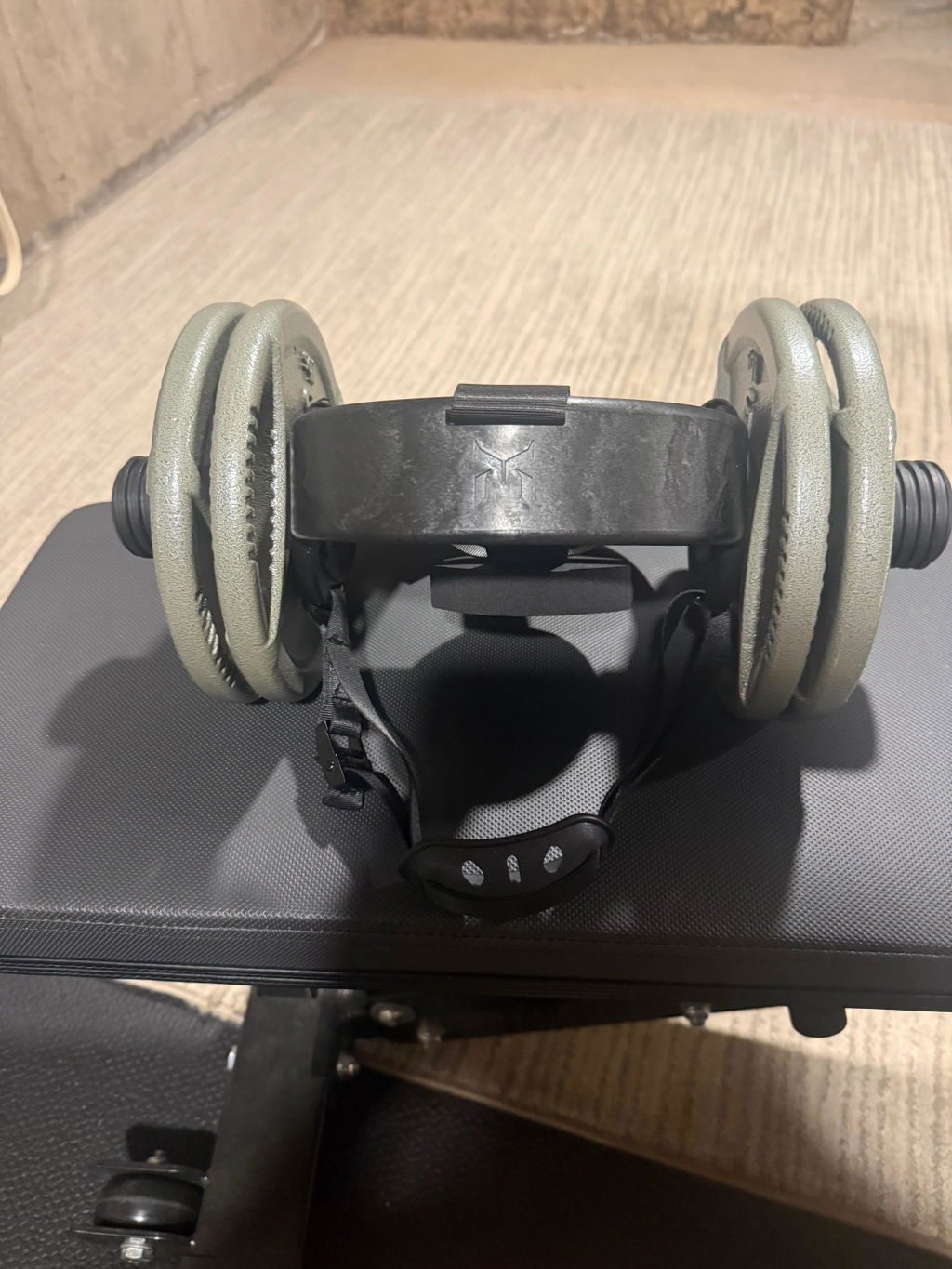
Its weak spot is the one this whole page is about. Three of the 135 reviews say the frame shifts or wobbles on side work. Two of them date from 2024, before the chin cup existed (it is missing from the product page the Wayback Machine saved on 15 May 2026). The third is from June 2026, and I cannot tell which version that owner had. The cup anchors the frame under the chin and fixes the first version's other complaint, a plain strap that choked a little on chin tucks. It adds nothing over the ears, which is where one reviewer wanted pads. So I cinch the cup until the frame does not turn when I shake my head, go lighter on the sides than on the back, and keep side bends slow.
Four of the 135 reviews mention a harness, a chain or D-rings, and two of those owners came from exactly where I did.
"I tried both with free weights hanging from a chain as well as connected it to my pulley tower… effective but not comfortable and somewhat limited degrees of motion."
EZ-HELM owner, five stars, who started on a cheap harness from Amazon"I own the typical boxing helmet that you can weight load with the longer chain, but those are only ideal for the facing forward workout."
Christian, reviewing Kensui's handheld EZ-NECK"I don't know how it would handle really heavy weight, probably a harness with a chain would be better for that."
The same EZ-HELM owner as the first quoteThat last one is fair, and it is why my strap is still in the drawer.
Keep The Harness
What I do now is ten minutes, three mornings a week, at the kitchen table. On my back: chin tucks into curls, three sets of ten. Face down over the edge of the table: extensions, three sets of ten, the one lift the strap already knew. On my side: bends, two sets each way, lighter than the rest. The first week was a 2.5 pound plate a side.

The small plates are the point. A pair of 2.5s and a pair of 5s covers months. The chain strap still comes out now and then for heavy extensions, because it is the better tool for hanging a lot of weight off the back of your head. Everything else goes on the helmet.

$199 · in stock · 100 day trial with free returns
| Kensui EZ-HELM V2 | Kensui EZ-NECK | Chain strap (DMoose) | Iron Neck Alpha Plus | Titan rack mount machine | |
|---|---|---|---|---|---|
| Price | $199 | PRO $49, MAX $129 | $35 | $89 | $149.97 on sale |
| How it loads | Plates on a sleeve at each ear | A plate post on a pad you hold to your head | A plate hanging from a chain | Bands or cable clipped to D-rings | Plates on a lever, head on a pad |
| Directions it trains well | Front, back, both sides (side work wobbles for some owners) | Front, back, both sides | Back (the maker says front and sides too) | Front, back and sides with bands, no rotation | Front, back, both sides |
| Rated to | 100 lb | 100 lb PRO, 200 lb MAX | 300 lb | Not over 100 lb (Garage Gym Reviews) | 110 lb |
| Wins on | All four directions, hands free | All four directions for $49 | Price and heavy extensions | Band work at any angle | Stability |
| Learn More | Learn More |
If $199 is more than you want to spend, the honest cheaper pick is also Kensui's. The EZ-NECK is a curved pad with a plate post and two handles that you hold against your head, $49 for the PRO and $129 for the MAX. It trains all four directions, with your hands doing the job the helmet's straps do. I wanted my hands free, so the helmet.
Do I need Olympic plates? The sleeves take any 2 inch Olympic plate. For 1 inch plates, Kensui sells a $27 adapter.
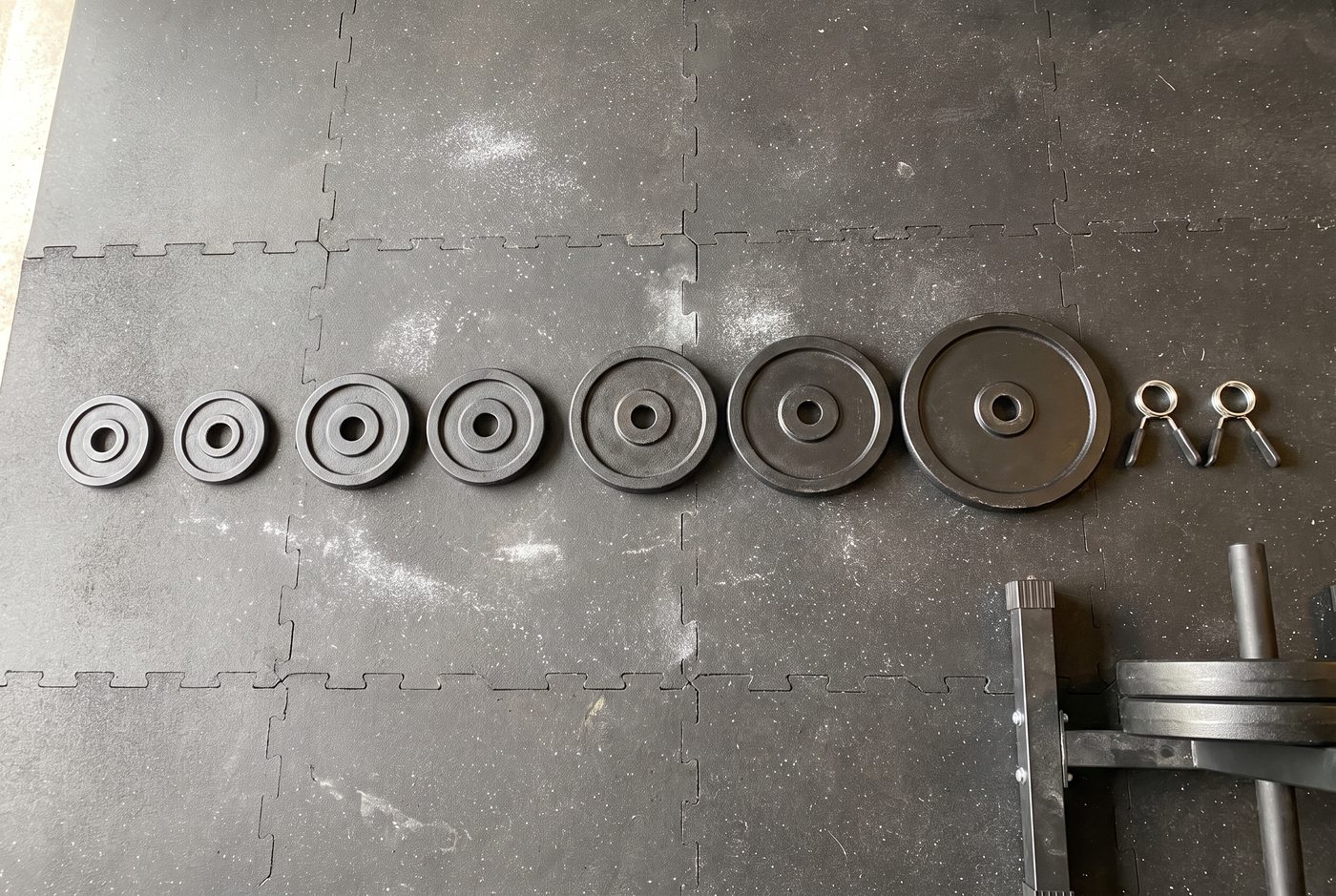
How heavy can it go? Kensui rates it to 100 pounds. DMoose rates its chain strap to 300, so for very heavy extensions, keep the chain.
100 Days To Find Out
Kensui gives the EZ-HELM a 100 day trial with free returns. Train all four directions for three months, and if your neck has not changed, send it back.
The Other Three Directions
Two years on a strap built one direction of my neck. A helmet with plates at the ears trains the other three for $199, and the strap can stay in the drawer for heavy days.
Get the EZ-HELM